I must admit that when our little tour group of 7, plus our leader, landed at the Havana International Airport, I was woefully ignorant of Cuba’s political history prior to 1950, and its geography. Our itinerary had us going by bus from Havana, the capitol, to Cienfuegos and then ending in Trinidad on Sunday. On Tuesday we would return to Havana via an overnight stay in Santa Clara. Wednesday and Thursday back to Havana and a nearby province. Back to Miami on Friday.
Each day an educational tour was scheduled, narrated by a Cuban guide. I was a dry sponge—a small dry kitchen sponge, that picks up a lot at the beginning, but later on starts to leak facts. Our first day was particularly challenging: “Understand Cuba with a Sociologist.” Most of our guides were experts in their fields. Tourism is a way to supplement their income, since the government salaries in 2024 are pitifully low. This is due to a combination of reasons, one of which is the US sanctions that choke off the profits of tourism as a source of revenue for the government. The socialist model of government took on the responsibility, since the Cuban Revolution, for administering important social and health services, and multi-level education. Our sociologist walking-tour guide was a history professor at the university in the Havana neighborhood called Vedado. For several hours he regaled us with innumerable facts, figures, and opinions, as we strolled around the neighborhood adjacent to the uni. He had a clear point of view that at times was questioned by our weeklong guide Rioger. Finally, after sensing mental exhaustion on the part of the newly arrived travelers, he sat us down at a local coffee shop and bought us drinks. Some of our group begged off and headed back to the B&B. Those of us who stayed sipped our café con leches and listened as a debate took place between the history prof and our #1 guide. The topic: which factors were most important in bringing Cuba to its knees financially? Our guide was no slouch in the political analysis department himself.
Day one, my takeaways: 1. Nobody seemed at all frightened about criticizing the government, and nobody spouted some “party line”; 2. Cuban espresso is really good.
One reason I like to write these travel posts is that I “do my own research” when I get back to make sure I have the information right and to fill holes in my knowledge. For example, I read quite a long Wiki entry on Cuba which covered a lot of Cuban history, starting with its “discovery” in 1492 by you-know-who. I encourage my readers to do the same and find out things you might have wrong. The section on slavery is very enlightening, and may help to explain the enormous success Cuba has made in developing a very integrated population.
On day two, another educational tour, this time of old Havana, was scheduled for the morning. The topic was the Afro-Cuban religious practices of Santeria. Unlike my previous experiences of how the Mayans in Mexico preserved their religious practices in the midst of the dominant Catholic Church, Santeria was brought by slaves from primarily West Africa and has syncretized with Catholic perspectives and holy figures in interesting ways. We were informed that in the current times, religious practices are allowed and tolerated by the government.


There are several sects of Santeria in present day Cuba. We stopped in several stores selling paraphernalia used in Santeria practices. Statues of Demigods and Catholic saints were for sale, along with decorative pottery used in ceremonies. Animal sacrifice is still a part of certain rituals. We passed by a menu showing the day’s available animals for purchase. One guide was himself a babalocha. He was ordained as a leader in his sect. He serves as an intermediary between his clients (supplicants who need spiritual guidance) and the pantheon of Yoruban demigods and supreme spirits. A bit like confession in Catholicism, but a with a more complex analysis of how to help individual practitioners struggling in their lives.
We stayed in small B&Bs, since most of the big hotels are government (military) built and run. The current sanctions discourage giving US$ to the Cuban government. That was okay with us because the B&B’s were quite nice, mostly properties that were once owned by wealthy Cubans who split for Miami. The Villa Colonial Deluxe Cubana was one of those, in the Vedado neighborhood of Havana, very inexpensive by US standards, but with an air of former elegance, and very comfortable.  All of our lodging was similarly elegant and privately owned.
Havana is still famous for its wide range of music and performers, from reggaeton to salsa, folk, and jazz. During our stay Havana hosted its annual jazz festival. We attended it on our last night at a magnificent warehouse turned art and music venue (Fabrica del Arte). The place was packed with beautiful diverse people from many countries.
Our first night in Havana we walked to a local small jazz bar, Havana Blues. We grabbed front row seats and watched a classic trio of guitars and percussion setting up, while we ordered drinks and nosh. Rum being the national drink of Cuba, and, often, too sweet for my tastes, I asked the bartender for something not sweet. He seemed excited by the idea and proceeded to invent a drink which I found delightful. Then the band began, with Cuban renditions of jazz standards
Out of the crowd a young woman got up and proceeded to play ferocious violin. It was thrilling. Then another woman jumped in and began energetic vocals. Frankly, it was better than 90% of what was honored at the Grammy’s last Sunday. (excepting Jon Batiste, Tracy Chapman and Joni Mitchell)
The next day, on the way to Trinidad, our group stopped in Cienfuegos—the Pearl of the South. It is a UNESCO World Heritage site, because of the classic Spanish style architecture built by wealthy sugar growers and industrialists in the late 1800s to early 1900s. Because of its UNESCO status, the buildings are in good shape. For those of you who are baseball fans, I counted six American baseball players born in this town.
Our itinerary had us stopping at a playa. Unfortunately, it was chilly and very windy. We had to settle for another fab lunch of langosta (Caribbean lobster) and platanos under an open shelter. Back on the bus; next stop Trinidad. Trinidad is also a World Heritage Site, for similar reasons. It was built in the 1500s, and has the narrow cobblestone streets of the period.
On the fifth day we headed back toward Havana via a two-night stop in Santa Clara. On our way was a stop to visit a “slow food, ecological farm”. I have been to many ecological or permaculture farms in the US. Greenpeace lists the 7 principles of ecological (permaculture) farming:
1 Food sovereignty
2 Benefitting farmers and rural communities
3 Smart food production and yields
4 Biodiversity and diverse seed systems
5 Sustainable soil health and cleaner water
6 Ecological pest protection
7 Climate resilient food production
This farm is a family business with three generations living on the same property. Like many farms like this, one immediate challenge is restoring the soil made infertile by decades of monocrop agriculture (sugar cane and tobacco) and chemical fertilizers. This family said it took a decade to rebuild the soil by adding animals and their manure back to the land, creating a self-sustaining organic fertilizer system, creating ponds for irrigation, and rotating crops with nitrogen-building properties.
Now they produce almost all the food for the family and enough to supply small local restaurants. In Cuba now, nearly 80% of its food is imported because of depleted soil and lack of trained farmers.
The senior member of the farm stated he envisioned 250,000 of these farms in the future. Right now, the lack of investment in manpower development and equipment means that ecological farming is limited to small scale, family farms in Cuba. Still, they see themselves a part of an international movement.
After a tractor ride back to the bus we drove into Santa Clara in time to set up lodging and head out for three bits of night life. First, we drank mojitos at a bar dedicated to the owner’s huge collection of Revolutionary paraphernalia.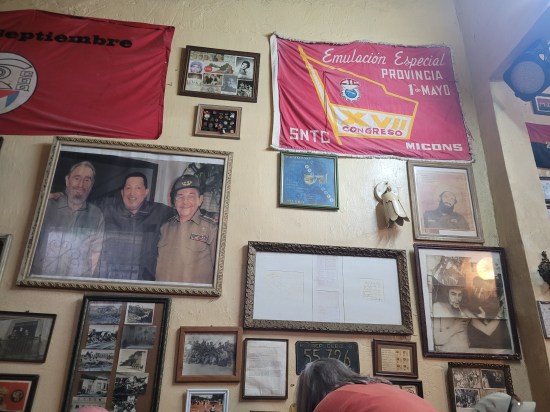 Second, we walked to a LGBT bar and services center. Thanks to WIKI, I now see that traditional attitudes associated with Catholicism started to change officially in 2019, with the ratification of a new constitution guaranteeing many new rights. It outlines in detail the recent history of LGBT rights that parallels in many ways the timeline in the US. The opposition remains in both countries, tied to conservative Christian churches.
On day 6 we returned to Havana and a new splendid B&B. We attended the annual jazz festival at Fabrica del Arte referenced in the first half of this post.
The final day was filled with joy and beauty. Before our final walk thru a lovely botanical garden featuring orchids of every type, a special treat was organized by our #1 guide. This was a trip to his neighborhood outside of Havana, where we were entertained by a group of 30 or so young girls from 6 to 14 learning to play guitars, ukes and other stringed instruments.
Now I am back in the snowless, brown winter of Minneapolis, with pictures and a slight tan for memories. But, wait! When I walk into the kitchen every morning I see something new: I can almost hear the birds calling where they hang beneath the LED sun. 
 Other states, other lives, other souls
My sister the small dry kitchen sponge.
LikeLike
Really interesting, Carol. My first thought, reading about your (I
guess) cautious admiration for Cuba, was that any country that doesn’t
let its citizens come and go as they please is not a country I’d want to
live in. But then I read that Cuba changed that in 2013, when it started
to let foreign tourists in. So I suppose you have to ask if it’s the
only country in the world that’s getting Communism right…Or is it not
so Communist anymore? Or maybe it’s just gotten adept at concealing abuses.
In any case, this was very colorful to read — and funny (the bit about
the sponge). You’re such an informed traveler — something the world
needs, since most of us gear up for a trip by checking restaurant reviews.
Hoping all’s well with you and Phil and the family —
Love,
Margo
LikeLiked by 1 person
Thank you Carol! I appreciated learning about your experience. The music sounded terrific! Sustainable agriculture will hopefully spread in Cuba, small but motivated.
Anne
LikeLike
Margo, thanks for the detailed comments. It’s still a one party state, but with an elected assembly. It calls itself Communist, but each country (China, Vietnam, Laos, Cuba) has made changes from the Marxist-Leninist model to fit into a global economy and allow some entrepreneuring . It’s hard to say how it would be doing if it had not been attacked by the US for 70 years. It justifies a siege-based government, always looking for spies and assassins, of which there were hundreds.
LikeLiked by 1 person