I don’t have a bucket list, per se. My choices of where to travel are based much more on finding connections to my life so far. They are often serendipitous. This post is about one of those trips: Cornwall, UK.
Minneapolis, where I live, is a few hours from a former mining town in southern Wisconsin named Mineral Point. We took the kids a couple of times during spring break, when the chance for an inexpensive warmer locale wasn’t possible in one week. It has several features that appeal to elementary school children, parents, and grandparents. One is its nearness to the House on a Rock, a kitschy midcentury obsession, best known for its needle point room zooming out over the valley below.
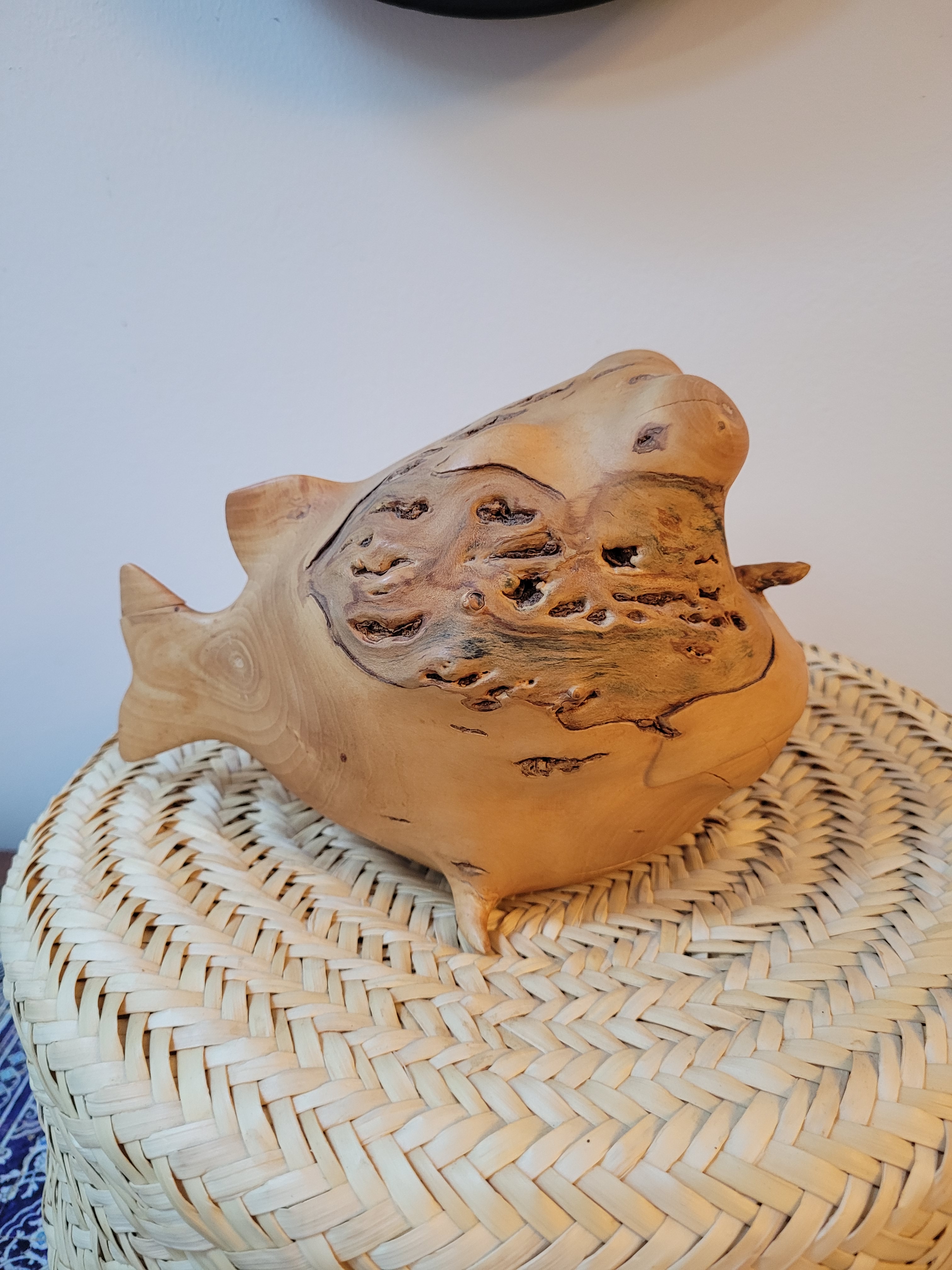 The second reason to visit is that downtown Mineral Point has become a venue for many local artists taking advantage of the many preserved Cornish buildings. Here is picture of a fish carved from a tree burl I bought many decades ago. There are also several examples of Frank Lloyd Wright structures nearby.
The final and most significant reason to visit is to see and learn the history and remains of the lead and zinc mining community named Pendarvis. There are preserved Cornish log cabins and row houses and docents to talk about the history. I remember being shocked to hear that the average lifespan of a Cornish lead miner was twenty-eight years! I just learned that there is a festival in September every year honoring the “great migration” , from Cornwall to Mineral Point and other Midwest towns from 1830-1850.
My interest was piqued again when I started watching a new rendition of the series Poldark, from books of historical fiction by the same name. It was shot in Cornwall and tells a dramatic love story set during that same period of the collapse of mining and famine that spurred the migration. This link shows amazing photos of the many storied Cornish beaches featured in the series.
The final weight on the scale that tipped me toward Cornwall, was looking at the brief information on my British ancestry that my father sent to me. My grandfather was raised in Bristol. Although it’s not officially in Cornwall, but in the county of Bristol in southwestern UK, it was close enough. Finally, my townhouse neighbor told me she was raised in Bristol and handed me over a grocery bag of travel guides on the UK. I invited my sister to come along. She later convinced me to head on south to the Isles of Scilly, which will be the subject of the next post.
When we landed in London, and started chatting with some of the locals, they would often ask “Where are you headed?” When we told them Cornwall, they invariably smiled wistfully, and said we had made a great choice. We had discovered early on in our planning that it would not be that easy to cover all of Cornwall in two weeks. There was only one flight and airport, which would land us in the middle coast of Cornwall. We would have to take a train from there to the bottom. We looked into renting a car, but they were expensive and would require us to drive on the left. I did that in New Zealand and almost killed myself turning right.
The best choice was the train. It would take us within 20 minutes of St. Ives and was speedy. It allowed us to watch the countryside unfold. We would transfer to a second train to St. Ives. No problem, until we learned that our train would be at least 30 minutes late. We had missed the connector! We started dragging our bags out of the station toward the unknown, as the sun was beginning to set. There began a series of experiences reflecting the small traditional town life of Cornwall. We happened upon an empty bus idling while it waited for its future passengers to disembark from the train. Sadly, it was not going our way. After hearing our tale of woe, the driver said “hop in and I will take you around to the St. Ives bus stop and set you on your way.” We got on the correct bus which ambled its way into town. We watched with amusement as a group of people got on at the next stop and spent at least five minutes asking for directions, laughing and chatting with the driver. After five, a kind of virtual drum beat started up with the other passengers who were eager to get on with the show. All in good spirits.
We got dropped off at a pub on the main road to Penzance near St. Ives. We headed toward our lodging for the next three days at Tregenna Castle. The video shows a lovely spot high above the bay. It did not show the one mile hike up a steep driveway to get to the castle. I am not sure what is the formula for computing the weight of a 40 # suitcase being dragged up a 10% incline, but for me, it was grueling. When we got to the top, and I caught my breath and looked around, it was truly a lovely spot.
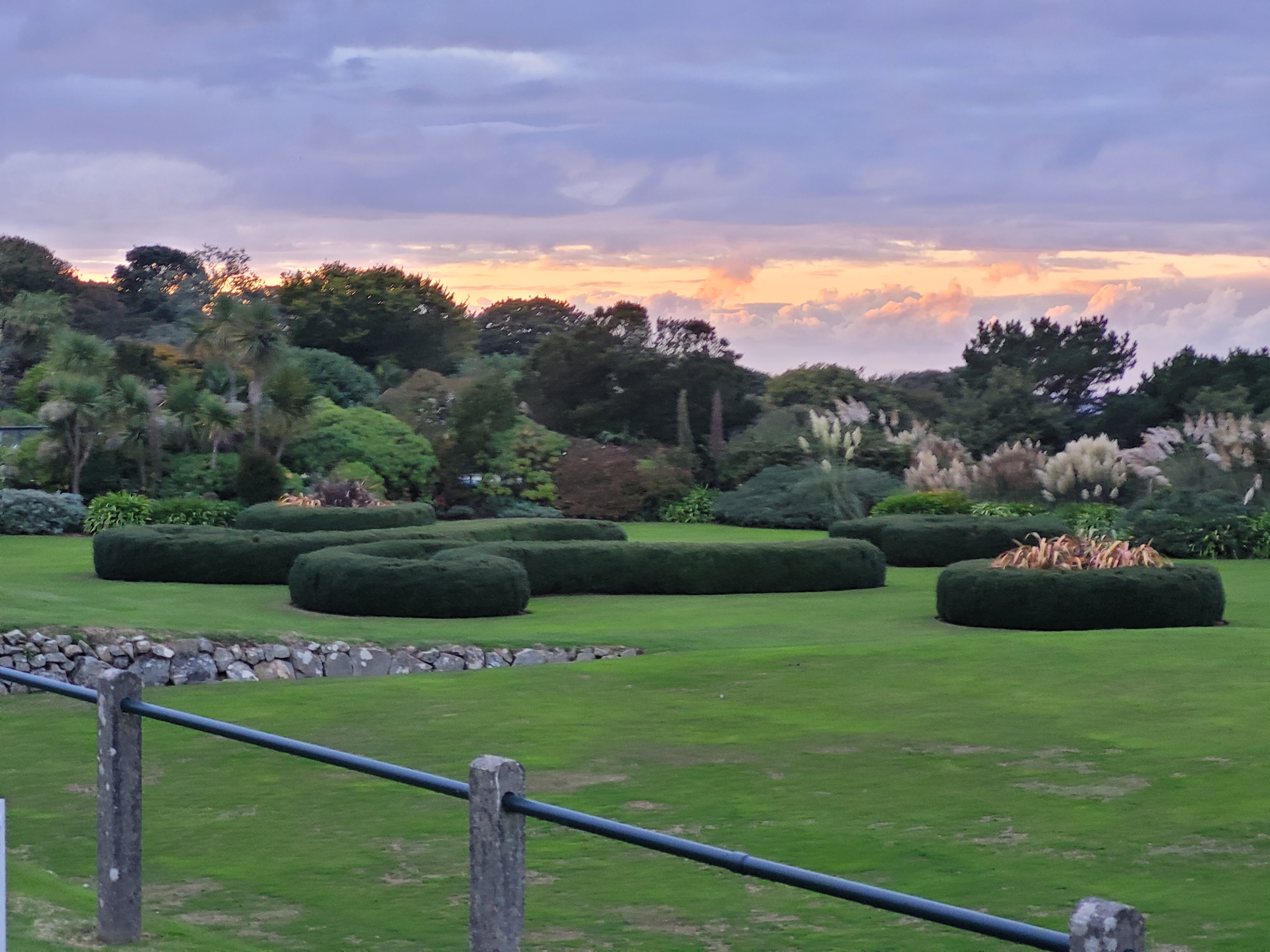 Once we could drop the luggage in the room, the trips down and up the path to the town and beach were easy. We had our first (and last) official pasty for lunch the next day. I confirmed that it is pronounced “pass tea”, and not “paste tea.” I was told that they were Cornish, but more specifically, miners’ food. It was a combined lunch box and sandwich that could be taken down into the mines. This link gives a funny history of the pasty, from the 13h century on, complete with superstitions.
Our path down to the main town took us to Porthmeor Beach, a famous surfing site. My sister wore her swimsuit, since she swims frequently in chilly weather at Jones Beach in Brooklyn with a friend. Not to be outdone, I switched into mine and followed her into the icy waters. 3 minutes later we were back on shore, drying off and  scrambling into our fall clothing. I think our next trip this way will be in May. So many gorgeous beaches! On the beach we saw our first sign that Britain and gin are like peanut butter and jelly. It may have been 55 degrees out, but with a gin and tonic in my hand, it was still summer.
Two days later, we grabbed the bus to Penzance, at the other side of the tip. The weather there was even more unpleasant—drizzling, cold and windy. I had brought 3 different kinds of rain wear, so we were equipped to walk along the boardwalk to a warm pool built into the edge of the beach, followed by another pub stop, and a trudge home. I have seen enough British murder mysteries, where people are always wearing jackets or sweaters, to know there will be rainy, cold days in the UK. Pretty quickly we discovered a broad interior walking path that wound around from the shore and the Penlee Museum to our B&B. It’s fun to walk along a path in the dark in a new town, where it feels safe and I feel like an insider. Two days later we headed to the ferry dock to depart for the Isles of Scilly, our last destination. It was still windy but sunny. I received an email from the ferry company advising passengers to forego the trip if they were planning a one-day visit. That would mean 5+ hours of travel across the Atlantic in very rough seas. We did not fit that category, so off we went. I was nervous but confident that I had an iron-clad stomach and would not get seasick. My sister is getting her sailing captain’s certificate from the New York sailing club, so she was also confident. So confident, she sat outside on the aft deck. I stayed inside and read my book, pretending I was riding on a train. One of us got pretty nauseous. You can guess which one. We arrived in Hugh Town in St. Mary’s Island harbor. We were thrilled to find that the ferry company would deliver our luggage to our next, up-a-hill, B&B.
My next post is about our five-day stay on the Isles of Scilly. I had not heard of them, but my sister heard from a British parent of one her piano students that it was the best place in Britain for a summer vacation. I remembered later that they figured briefly as a hiding place during a dangerous period in Poldark, so it counted as a connection as well. Just yesterday, the US midterm election day, I made another Scilly connection. I brought a book to help pass the long hours I was sitting as a volunteer for voter protection: This Is Going to Hurt, by Adam Kay, former NHS doctor. It’s full of his diary entries while beginning his medical career. One poignant entry was about sitting with a pregnant woman just diagnosed with metastatic breast cancer. After telling her the news, he is shocked at her response:
And now I’m sitting with a woman who’s asking me if she shouldn’t have her ashes scattered on the Scilly Isles. It’s her favorite spot, but she doesn’t want it to be a sad place for her family once she’s gone. (p.60)
 Other states, other lives, other souls
This was a lot of fun, and so interesting, Carol. George Peters, mom’s second husband’s grandfather came from Cornwall, and according to his lore, was a miner in the UP. My mom learned to make “pasties” and they were delicious. When John and I were on our WW1 tour a few years ago, we had a day stop in Southhampton where we roamed the town. There was a sweet and savory pastie shop and we indulged- cute little British “shoppe”. I can see you dragging your suitcase and feel for you – we just returned from seeing the kids in Athens and we had a few of those moments. We were there for 5 weeks to help them during Polycraty’s treatments so it wasn’t tour or vacation time. However, despite the horrific chemo and radiation he was going through we were happy to be with them and to get to know our just turning 4 year old grandson. (Full of energy and English and Greek) I’ll get to the links in your article and look forward to reading more. I haven’t had the inclination to write anything since Polycraty’s diagnosis. But his treatments are over and they are hopeful…..
Take care—
Terry
Poetry emerged with the chant and the dance. ————Edward Hirsch What wisdom can you find that is greater than kindness? ———— Jean Jacques Rousseau
>
LikeLike
Forgot to say- we have stayed in Mineral Point in one of the “Miner’s Cottages”. My artist friend, Anne Von Ehr, has taught there in there summer program – we were there off season and it was great
Poetry emerged with the chant and the dance. ————Edward Hirsch What wisdom can you find that is greater than kindness? ———— Jean Jacques Rousseau
>
LikeLike
Forgot to say we visited Cornwall – just a short two day- with George and Ginny on a quick British Isles Trip, back in the 80s. We were not free to roam (George in charge). Wish we had had more time. We are aiming at East Anglia for a trip some day. (Sebald territory)
Poetry emerged with the chant and the dance. ————Edward Hirsch What wisdom can you find that is greater than kindness? ———— Jean Jacques Rousseau
>
LikeLike