(ED: One main goal of this travel blog is to encourage people to plan their own travel, rather than opting for group travel designed and led by professionals. Why?
It’s less expensive
You choose your own adventures and can modify as you go along
You immerse yourself in other cultures more readily
Some research shows that planning travel is one of the best parts of vacation travel
This post is an example of what can happen regarding #2.)
My sister and I just returned from a two week “ancestry” trip to Cornwall starting and ending in London. Our grandfather emigrated from Bristol to the United States around the first world war, at age 18, and we wanted to dip our toes in the region that imprinted a quarter of our DNA. We chose late September to early October to avoid the hordes of summer tourists. To our dismay, Queen Elizabeth died and a gigantic funeral memorial was planned for London the day before we were to fly to Heathrow. Moreover, rail strikes were in the offing. Brexiteers were nervous as the pound was dropping and inflation was rising. As if those events weren’t enough to start us worrying about the trip, I managed to injure my calf and, subsequently, leg and hip muscles the first day I arrived in Brooklyn to meet up with my sister.
None of this ended up affecting our overall itinerary, however. Our goal was to take the fast train from London to visit two towns at the southern tip of Cornwall. After four days on Cornwall, take a ferry to the Isles of Scilly. After five days on Scilly, ferry back to Penzance and train back to London for the flight home.
Thanks to the miracle of modern pain killers (no opioids!) and help from my younger sister in negotiating transit and narrow old B&B stairways with my heavy suitcase, we covered all the bases. But, as can happen when you plan your own travel with less-than-complete information, the experiences we had along the way were different from what we expected.
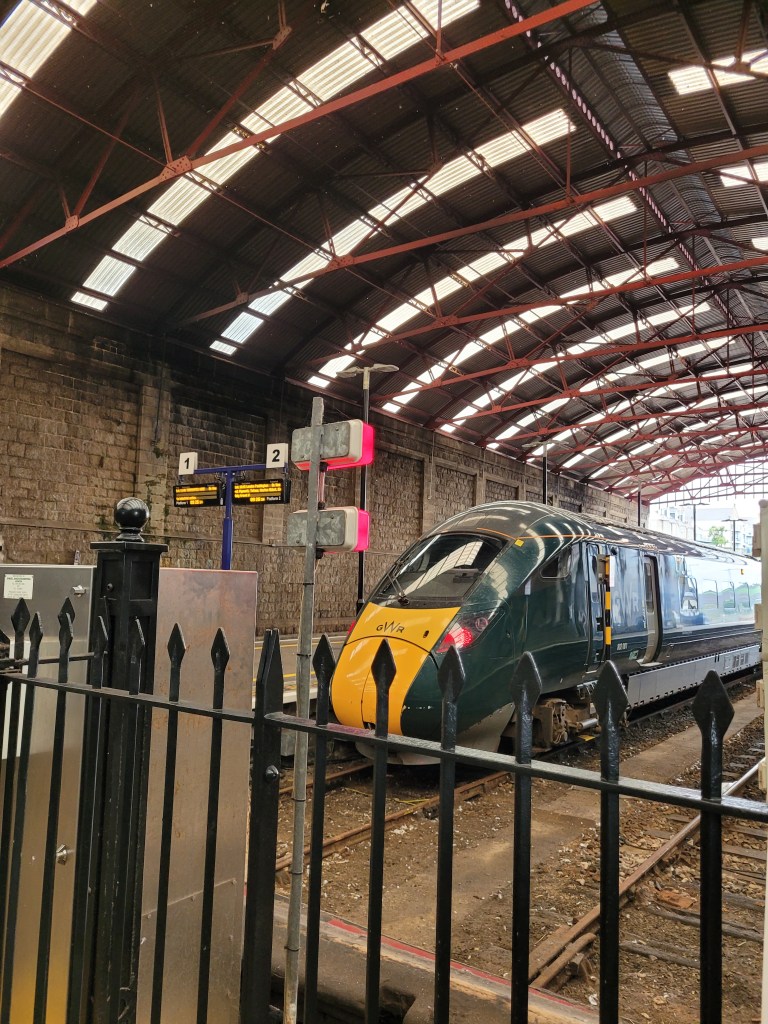
Paddington Station
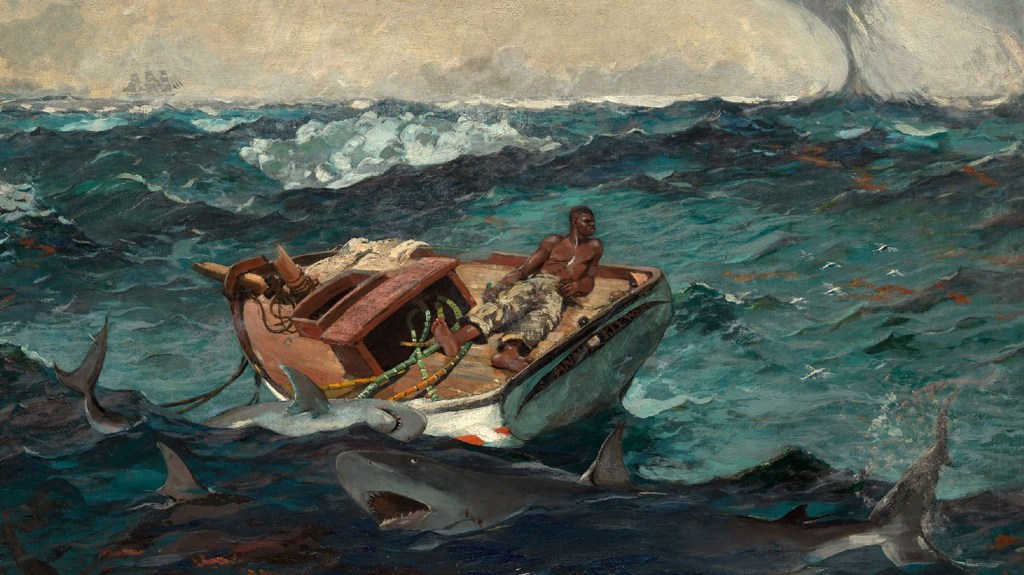
Before leaving for rural Cornwall, we sampled some high culture in London. The London National Gallery was hosting a first-ever exhibit of works by Winslow Homer, the American painter. He is best known for his dramatic renditions of sailing ships at sea. We have one print in our bathroom. Since I am a landlubber by birth, I’ve been a little “meh” on Homer. My husband, however, who spent much of his youth on the East Coast messing about in small sailboats, is a big fan. Homer turned out to be much more interesting to me as I learned of his other sources of inspiration. He lived through major conflicts in the last quarter of the 19th century in North America:
From his sketches of battle and camp life, to dazzling tropical views and darker restless seascapes, the works reflect Homer’s interest in the pressing issues of his time; conflict, race, and the relationship between humankind and the environment – issues still relevant for us today.
After four days in London, we took the fast train down to St. Ives on the Atlantic coast. The weather was cooler and windier than we expected, so the beach-bumming plan had to be cancelled for more autumnal and indoor pursuits.
We started with a visit to the Barbara Hepworth Museum and Sculpture Garden in St. Ives. Hepworth is best known in the US for creating the granite egg-shaped sculpture in front of the UN building.Her style and choice of materials reflected, perhaps, the multicultural universal and abstract vision of the UN.
In St. Ives she situated many of her sculptures among plants in a beautiful garden that she created outside her studio. Southern Cornwall is the warmest part of the UK and can support a much wider range of plant and tree life than the north. After two days in lovely but chilly St. Ives, we bussed to Penzance, in order to take the ferry to Isles of Scilly. Facing some rainy days, we opted for more art. Penzance houses the Penlee House and Museum, which highlights the work of the Newlyn artists. There was a large exhibition of works by Walter Langley, celebrating 100 years since his death. Unlike Barbara Hepworth, Langley chose to represent a very specific reality in his work–the common folk of the western coastal fishing towns of Cornwall. The show features large and small drawings and paintings of people going about their business fishing, waiting for the fleet to return, facing tragedy, and interacting with each other. He came from those people and wanted to memorialize their lives. Both local artists were inspiring in their disparate visions.
Then after 10 days in the south we returned to London. (Our time on the Isles of Scilly merits a separate post.) We revisited the National Gallery to see the classical paintings of the European Masters from the 15th to 19th centuries.
Over my adult years, I have been to many European and New York City museums that feature the Great Masters of Western Art. I have also seen lots of famous 20th century modern art. It’s common for people visiting the latter to hear visitors puzzling over why they should appreciate some of it, like Jackson Pollock, Kandinsky, Mondrian, and so on.
I must admit to a fair amount of disinterest in abstract art. I have come to understand it as a conversation among artists who are asking themselves “What is art?”, “What can I do that’s new?” Museums are places where non-artists can get in on the conversation, either rejoicing in the process and products or wondering what everybody else sees in it. Museums also organize fund-raising so that living artists can be paid well for work that reflects their talent and inspiration.This time, as I moved slowly through the classic rooms of the permanent collection, I found myself frowning at the degree to which the desires of patrons dictated the artists’ subject matter. Much of the art showed scenes meant to publicize the glories of the victorious Christian Church—Bible stories, mystical events, adoration of Mary and other saints. What was the conversation artists were having then? “How do I get my artistic work paid for?” “How do I get a better handle on how cherubs are supposed to look?” “What are some gruesome pictures of what awaits sinners in hell, so Christians will fear God?” and most important, perhaps, “how do I please the clergymen who are paying for this work?” No doubt the artists were talented, but they were essentially being paid to produce religious propaganda.
The big change in subject matter came about when the merchant class began to challenge the dominance of the Church, particularly in secular Holland. In the “Dutch Golden Age” of the 16th and 17th centuries, there were fewer cherubs. Instead, the merchants commissioned giant portraits of their bourgeois family members, merchants sitting around enjoying the fruits of their labor, well-dressed children holding pets—and, occasionally, scenes of city life. They were skillfully done and, to me, were a welcome change from tedious religious propaganda. But, still, so many are early versions of selfies. They were quite realistic, often celebrating quite homely family members, well-fed merchants, and the finest clothing. I asked myself: How else would these great artists get paid for their time? Peasants couldn’t afford to subsidize Rembrandt. A book review I discovered in the New York Times archives from 1986 gives one answer to that question: “Above all he pleased his patrons” by James Snyder. The book reviewed was Rembrandt—His Life, His Paintings, by Gary Schwartz.
The case of Van Gogh offers a different model of patronage. His brother Theodore supported him, but, sadly, could not keep Vincent from falling into despair and ending his life. Van Gogh’s subjects reflected his own vision, not those of the ruling classes for the Great Masters. His paintings were only sold after his death. Now he is beloved by all.
Today’s art world is being despoiled by billionaires competing for who can spend the most money on the latest acquisition. For them, art is an investment, or a way to flash their ungodly wealth. “Should I buy another yacht or a Jackson Pollock to put on my wall to show off my financial success? The moral of my story is: When we go to a museum, let’s ask ourselves “whose purpose does this painting serve?”
2 thoughts on “The Cornwall Trip that Took an Unexpected Turn”
I enjoy reading your open minded and eyes open re-evaluation. I see so many people rush by having already decided they aren’t interested. Thanks Carol.



 Other states, other lives, other souls
I enjoy reading your open minded and eyes open re-evaluation. I see so many people rush by having already decided they aren’t interested. Thanks Carol.
LikeLike
Hi Carol, Nice read! xxxx
LikeLike