

Six years ago, my husband and I spent one early spring month mostly car camping around the southwest of the US. We ranged from the boundary with Mexico to the lower part of Utah, covering parts of Texas, New Mexico, Arizona, Utah, and the “four corners”—where New Mexico, Utah, Colorado, and Arizona touch perfectly like jigsaw puzzle pieces. It was terrific, complete with stunning flowering trees and plants—what was labelled a super bloom–in this normally harsh desert ecosystem.
We fell in love with the solid yellow blooming creosote trees, despite their more sinister reputation as a toxic wood preservative. It is toxic, but the creosote used as a wood preservative is mostly a petrochemical product, which is now banned for its many dangers to health. The creosote bushes are used for their many healing properties. Our bedroom is now creosote yellow, a happy reminder of that time. The varied forms of cacti were covered with delicate, colored blooms, while retaining their “don’t touch me” presence.
We started with several national parks along the border, and then moved north to Lake Mead and the Grand Canyon. I have previously written about our strange camp site/cum homeless encampment in a blog post from that time. We then camped on Navajo land by the Glen Canyon dam and Lake Powell. We toured the splendid Antelope Canyon by boat. Above the natural splendor loomed a large coal plant, on the top, within the Navajo Nation boundaries.
Moving north, we practiced challenging mountain biking in Dead Horse Point State Park in Moab, Utah. We were so charmed by the beautiful views along the rim trail and energized by the thrill of bouncing over big sheets of granite, we bought our own bikes when we got home.
We ended our trip by climbing up ancient cliff dwellings at Mesa Verde and before leaving town I bought three pairs of Navajo and Hopi earrings from the local jewelry shop. On the advice of a Mesa Verde Park ranger, I went to the pawn shop in the back for real vintage finds. I learned that toothpaste was the safer way to clean tarnished silver.
We marveled at the large ravens who seemed to own the red rocks and soared far above the harsh terrain as if tourists themselves. We saw even larger California condors navigating the air currents in the Grand Canyon. I bought a set of small clay ravens and made a necklace and earrings to honor these noble birds.
Our sound track for that road trip was primarily tied to the geography we were passing through–Toni Hillerman detective novels about life on the massive Navajo reservation, and an audible version of Willa Cather’s excellent novel about the Chihuahuan Desert and its denizens in the mid 1800s—Death Comes for the Archbishop.
Now six years later with the pandemic in the rearview mirror, we made a second shorter trip back to this special part of the world we had loved so much. Much had changed and some had stayed the same. We skipped Texas and went right to Silver City, New Mexico, to meet up with some avid hiker friends who had been enjoying warmer weather than Minnesota for almost a month. Silver City is not too far from the Mexico border. It is a small old town named for the silver mines than we encountered as multi-colored pyramids on the way through the mountain pass into town.
Our soundtrack this time was Coleman McCarthy’s book Comanche Moon. This was a similar timeframe to Death Comes for the Archbishop, but honored the west Texas plains, rather than the more western Chihuahuan desert. The arc of the story is the battle between the colonial whites and buffalo-hunting, warrior Comanches for the land. It’s an engrossing novel of cowboys and Indians, but it is refreshing in drawing detailed portraits of Comanche life and leaders, as well as the Texas rangers. It is brutally realistic.
So far on this return trip we had not encountered any spring wildflowers, unlike six years ago. The weather was spring-like (50-65F), but it was very dry. Our friends took us to the Gila cliff dwellings, built by the ancient Mogollon peoples in 1200. They only occupied this fortress-like setting for about 200 years, and then moved on. The Gila mountains also provided us with lovely hot springs, but then it was time for us to move on as well.

We drove all the next day to get to Page, AZ, a border town with Utah at the edge of the massive Navajo Nation. It is also near Glen Canyon Dam on Lake Powell, which we visited in our earlier trip. This time we intended to see Antelope Canyon by foot, rather than boat. It had become a very popular slot canyon on the rez. It was booked, so we reserved a spot on the Waterhole Canyon tour. It was also on the rez, but less touristy. It was gorgeous. Our young Navajo guide was very sweet and let us stop to take pictures as much as we wanted. This canyon and its desert surroundings were his playground as a child.

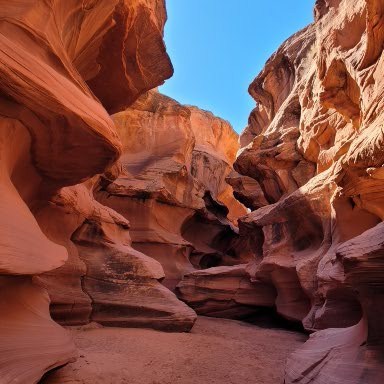
Page was where I started using the mountain bike I brought. We stumbled onto a non-obvious entrance to the Rim Trail, thanks to a passing biker. It’s a 10-mile loop of red dirt narrow trail that circles the outer edges of the small city of Page. It runs mostly below city level, so you don’t see any of the town, but, rather, teeter on the edge with magnificent views of the valley and Antelope Canyon. Easy enough for this senior, but not if you distrust your ability to stay on the path as it dips and climbs and snakes along the edge of a ravine.
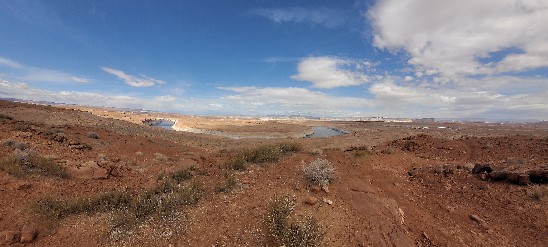
Some things have changed in this area since 2016. First the good news. The coal plant was taken down in 2020. Right now the site is being reused for more forward-looking uses, thanks to advocacy by environmentalists from the Hopi and Navajo tribes. Then the bad news. The Lake Powell reservoir is now the lowest it has been since it was completed, after ten years, in 1966. Drought, heat and continuing demands on the Colorado River from population centers in Arizona are drawing down the river and reservoir. Do humans have the right to drain water resources for a whole region in order to enjoy a non-desert lifestyle? In 2020 Phoenix endured the highest number of days above 100 in its history (145!) How much excess energy does it take to keep the former snowbirds comfortable? Will the city place restrictions on how low people can set their AC thermostats? As I am writing this, Google sent me a news flash warning that the Lake Powell/Dam management may limit water delivery to downstream Colorado users to avoid more serious draw-downs of Lake Powell reservoir.
After two hours, I worried about getting lost, so I followed a steep uphill by a faded sign with “TH” (trailhead, I guessed). At the top was a parking lot for trail users. I set my GPS for the motel and walked the bike across the lot to the sidewalk. As soon as I got to the sidewalk, my front tire started to lose air rapidly and by the time I got to the corner, all the air was gone. Luckily, I had my phone so I could call my hero, who had hiked the trail, and summon him in the car to pick me up.
I wondered why the flat tire only appeared after I had left the trail. At the bike shop I found out why. They pulled out three small thorns. They said the plants with the thorns were creepers and liked to grow in harsh conditions, such as the edge of parking lots! An easy fix, and we were back on the road headed to Moab and Dead Horse Point State Park. The Dead Horse Point and Arches National Park just outside Moab were just as we had left them six years ago. No flat tires and no mishaps. Red rock splendor and sweeping vistas. Now we are home and it’s mid-April and it’s alternately sleeting, raining, snowing and hailing.
 Other states, other lives, other souls
You always amaze me. Thinking I read this before or part of it. I don’t think I could keep up with you! It has been a long time since John and I “hiked/walked” around Nelson Lake in Batavia- gently rolling 3 1/2 miles with lots of stops to look at emerging ephemerals and listening for birds- not many this morning. And I am tired! We hosted John’s sister and husband yesterday for 5 hours so it could have some it going to do with that. Man,I am starting to feel age….hopefully, with the weather cooperating we will get out more and do more than our usual 2 milers. Love your “other souls”- appreciate the early email version. terry
Poetry emerged with the chant and the dance. ————Edward Hirsch
>
LikeLike