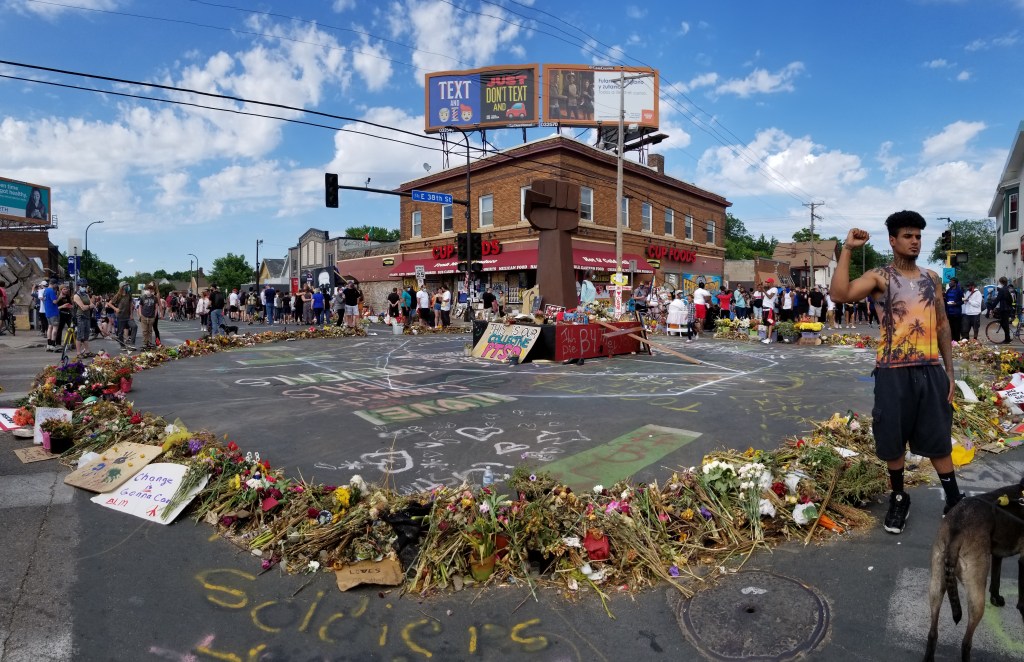
George Floyd and George Floyd Square have become known since 2020 in many parts of the world. Floyd’s torture and pointless death at the hands and knee of a now convicted police officer have revitalized the movement against discriminatory and ham-fisted police brutality—not just in Minneapolis, but in towns and cities across the country.
George Floyd Square, at the center of 38th Street and Chicago Avenue in south-central Minneapolis, has even become a spiritual travel destination for some and its fate is currently in dispute. Is it an important memorial that must be preserved; is it an important experiment in police-free public security; is it a “no-go” area, rife with crime and patrolled by gangs? I leave that analysis to the reader for now. My goal for this post is to wind back the clock on this neighborhood to give the reader a longer and wider context beyond today’s headlines.
South-central Minneapolis has been a hotbed for democratic (small d) activism for over 50 years. I lived in two south- central neighborhoods, Philips and Powderhorn Park, for 15 of those years, from 1975 to 1990. My then husband and I returned from grad schooling in the Bay Area to Minneapolis in 1974. We were already democratic activists, due to the Vietnam war, the Women’s Liberation Movement, and the Black Power movement. We chose to live in south-central because we learned that it was the home of an underground newspaper-100 Flowers-and a burgeoning neighborhood food coop movement. There were similar papers in the Bay Area and Berkeley that signified large enough movements to support a noncommercial paper. There were also cooperative groceries in the Bay Area, but they were huge supermarkets, stemming from an earlier anti-capitalist period and did not have the localist, organic food emphasis of the Minneapolis movement.
In the 60’s and 70’s the various social movements in Minneapolis tended to be separated ethnically, based on the priority of causes and lingering racism. Today’s intersectionality is a welcome change. The American Indian Movement (AIM) was launched in south-central in 1968, with a focus on urban Indians uprooted from their cultures. An historic Black middle class neighborhood flourished in south-central from the 1930’s through the 70’s, despite many restrictive covenants in other neighborhoods. Its northwestern boundary was 38th and Chicago. The Twin Cities Women’s Union rose up to represent second wave feminism in the mid-70’s and was housed in a south-central neighborhood. The local chapter of the New American Movement, launched in Davenport, Iowa in 1972, was housed in south-central. It was a precursor to the Democratic Socialists of America and one of many New Left organizations that arose in opposition to the Vietnam war and anti-colonial national liberation struggles.
By 1975 a local nondemocratic left organization rose up within the food cooperative movement. It was very secretive, led by a uber-secretive single leader, and many later came to see it as a cult. Its highly aggressive tactics and divisive ideology cut a swath through the predominantly White left organizations in south-central neighborhoods. The Women’s Union and New American Movement were shut down. The food coop partisans fought back and eventually the organic coop movement continued, as it has to this day.
100 Flowers newspaper only lasted for two years but was replaced by others. Its current iteration is called Southside Pride and it is alive and kicking today. Its Editor Ed Felien was the original impetus for 100 Flowers 50 years ago!
These neighborhoods, Philips and Powderhorn, are still very diverse both racially and economically. They have never been high income neighborhoods. When I first moved into Philips in 1975, part of a modest income couple, I lived communally with several other couples and a few rotating singles as renters. This was a common way to keep housing costs low to pursue our dreams. At that time owners of large old houses were willing to rent to unrelated groups, as long as we paid the rent on time and didn’t bust anything.
By the late 70’s some of us had higher incomes and one couple bought a triplex in the Powderhorn Park neighborhood. After I had my first child and two years later got divorced, the idea of living on the park in one of the triplex apartments became very appealing. By that time a new activist/arts organization had arisen called at first Powderhorn Puppet Theater and then by 1975 In the Heart of the Beast Puppet and Mask Theater (HOBT). Its annual May Day Parade ending in the park, and followed by a Tree of Life ritual, was a friendly mix of activist local political groups, hippies and neighborhood residents. An organization and ritual like this helped people to identify strongly with this neighborhood. Also, their practice of inviting volunteers to create puppets using recycled materials appropriate for the annual feel-good progressive theme reinforced the participatory feel of the neighborhood.

During the 1980’s the city’s leaders embarked on an aggressive downtown development project, using a strategy of tax increment financing, or TIF. The TIF model of development and redevelopment caused many lower income neighborhoods to object, believing that the TIF incentives did not result in the promised help for existing lower income neighborhoods. To head off this criticism in 1989 the city launched a charm offensive called the Neighborhood Revitalization Program (NRP), which funneled $20 million per year for twenty years to 70-odd neighborhood organizations to decide how best to use the money.
In 1987 HOBT had bought a former porno theater on Lake Street and 14th Street for its expanded mission. The metaphorical and actual revitalization represented by HOBT’s new digs illustrated a non-gentrifying approach to neighborhoods. I wrote an Op-ed piece for the Star Tribune on this theme which HOBT used for fund-raising purposes many years after.
With the NRP program also came the crack epidemic in the late 80’s. There was a new uptick in crime and shootings that rocked the south-central neighborhoods. By 1987 my husband and I had bought a home four blocks south of the triplex on the same street. Our block had the same diversity and esprit de corps of many south-central neighborhoods. Neighborhood organizations and block clubs fought back against the “dangerous” reputation being portrayed by local media of our beloved Powderhorn Park. Does all of this sound familiar to those of you living in south-central during current times? By the way, Minneapolis police were considered brutes by us all back then too.
Nonetheless, after our 10-year old’s bike was stolen twice by groups of kids and he became afraid to ride his bike around, we panicked and sold our house to become the local Walker Methodist Church parsonage. We moved to Linden Hills, a higher income community on the southwestern edge of the city, and near a lake as well. Twenty years later we retired and downsized to a different west Minneapolis neighborhood-Bryn Mawr- where a beautifully-designed small townhouse complex also gives us that “know all your neighbors” experience. Ironically, it is celebrating its 50-year anniversary this year, so in a way we have come full circle or, better, full spiral. I am wishing south-central and GFS an upward spiraling summer as well.
 Other states, other lives, other souls
I often travel on 38th Street and appreciate this history. When family comes from out of state, I take them to George Floyd Square. The last time we were there we met George Floyd’s Aunt Angela. She was very gracious.
Thank you Carol and Happy Birthday! I’ll never forget two years ago when we celebrated your birthday in Iran.
LikeLike
Wow, that was fortunate. I hope they make it into a genuine centerpiece.
LikeLike
Happy Birthday, Carol!
LikeLike
how’s the hip doing? You looked remarkable already in August/
LikeLike
A great history Carol! Enjoyed reading it. A lot of memories not all good!
So happy birthday and grateful to have worked alongside you in our struggle for social justice all these years. The struggle continues. Abrazos Joey
LikeLike
Great history Carol. Many memories of 1970s not all good. Happy birthday. So proud to be your friend and comrade in our movement for social justice all these years!
LikeLike
It was fun to read about the old days. I’d like to read even more!
LikeLike
I want to know more about the “non-democratic”left organization that started in 1975. What was it called? By the Way, Happy Birthday! –yer sis
LikeLike
The Coop Organization, or CO. There’s a new documentary about that history called “Coop Wars”. http://www.radicalrootsfilm.com/ That’s the Trailer. It tells you how to stream it. I was kicked out of the New Amercan Movement by the CO, who immediately tried to recruit me after that.
LikeLike
I enjoy your writing and this piece about some of the history of S Minneapolis reminded me of what’s so special about it. Happy birthday, dear Carol. I hope it’s a wonderful day! Wishing you many more adventures in the year ahead. ❤️ With love, Shelley
LikeLike
Thanks, Shelley. It was an amazing period and place for peoples’ uprisings in the US.
LikeLike
Hey Carol, my dear friend, I hope you’re having a wonderfully happy and satisfying birthday. It is a happy day for me when I can exchange a few thoughts with you on justice, change, community, and the history of change in our community.
Appropriately for your celebrating your birthday, you have served up some tasty bits that can seed a continuing discussion about advancing social, environmental and economiic justice in the Twin Cities.
A couple of quick thoughts:
First, THANKS! Thanks for your engagement, your travels, your writings and your generosity in all of it.
Second, It’s interesting that many of the activist groups you mentioned were not as central to my experiences. I experienced our local social change as being rooted in two things: One, broad values-based movements that influenced formal institutions and community based activism (women’s and gender identity movements, anti poverty, anti racism, ecological sustainability) And two, local hubs. Some of the hubs I experienced as influential included: the Community Clinic movement, the Farmer Labor Association, legal rights groups, Walker Church and other faith-based orgs, artist lofts, Southside Community Enterprises, Neighborhood organizations, Cooperating Fund Drive (later Community Solutions Fund) student groups in the University and colleges, I remember these hubs connecting important organizations and yielding enduring legacies. While there were plenty of divisions of opinion among these connecting groups, generally they suffered less from all-out fights for orthodoxy of win-loose control.
Thanks for sparking the conversation. I’m so glad you were born.
LikeLike
Yes, those too. Though I was specifically targeting orgs in and around south central MPls and George Floyd Square. It was an important time for all kinds of progressive movements and we can be grateful that we were alive to take part.
LikeLike
Yes. An important time. Grateful. I like the way you think.
LikeLike
Hi Carol, I really appreciate your research, memory and reconstruction of the progressive activism in south Minneapolis through the years! And I so agree that we have been very lucky to have been involved and to learn so much.
I am a fan of your blogs which always have interesting or surprising descriptions and insights.
Happy Birthday!
I am so glad we have shared so much of our lives!
Onward!
LikeLike
Happy Birthday Carol!! I love seeing your editorial piece. The youth program at HOBT that grew when they first bought that building was really powerful! So many stories and forces weaving through your blog. It’s great to remember them as we are watching the voting today..
xoxo
Mary Karen
LikeLike
I enjoy reading about some of the historical features of South-Central Minneapolis. The history of racial inequity is profound, especially for Black and Indigenous folks.
Thanks for the write-up of the anti-war movement and coop history in Minneapolis. There was good reason for many people gathering in those specific neighborhoods during that time. It is a joy to trace some of our family stories that overlap with yours, i.e. Walker Church, the parsonage…
Happy Birthday! Hope you are having a fabulous day.
LikeLike
Enjoyed reading this. It is a goldmine–lots of very interesting details from the past which is so important to understand. As a transplanted Minnesotan, all of this history is very meaningful for me to understand present day events. Thank You! I will also check your other blogs as well. Also, wish you a super birthday week and a wonderful and healthy year ahead. Look forward to reading more of your blogs!
LikeLike