(Note: Readers familiar with my travel blog will know that I try not to describe the obvious about places I have traveled. How many ways can I talk about white sand, sun and wind? All good, but you can learn that anywhere.}
A few months ago, I read the new book by Kim Stanley Robinson called Ministry for the Future. It is science fiction the way I like it. A lot of science and utopian fiction. It starts in 2026 when a climate change catastrophe in India causes the United Nations to appoint a committee of experts to address the predicted climate and environmental deterioration of Earth. It is designated The Ministry for the Future. The future unliveability of Earth is often cited as the reason for the several extraterrestrial terraforming novels Robinson has written—Aurora and the Mars Trilogy among them.
Ministry is a speculative blueprint for how climate change and the destruction of species could be mitigated thru enough will and a series of strategies and tactics. Some of them are already in limited use, some are in discussion, and others are made up. A tour de force.
One key tactic which is already in use is desalination. As the planet’s temperature rises, water shortages in arid and semiarid countries will increase. Water, water everywhere, but 97% of it is seawater. There are many countries currently using desalination to produce enough clean water for their economic and population needs. I just learned that Saudi Arabia is the top user of desalination technology in the world. Little Aruba is another one. Semi-arid Aruba started desalinating seawater over one hundred years ago, when the colonial Dutch needed clean water for their gold mining operations. By the 1930s upscaled methods were introduced. There has been a steady improvement in the processes until now Aruba is seen as a model for high standards and efficiency. This success has allowed the Aruban economy to improve greatly through tourism and industry. In 2020 the coronavirus crippled tourism, but the vaccines should eventually bring that back again. This cute little YouTube video explains the current desalination process: www.youtube.com/watch?v=Ynf8ys72Iu8. If you are really into this topic, here is a PDF report from UNESCO that describes the history and stages of improvement for the 85 years of desalination in Aruba.
As I sit in Aruba writing this post, I have a bottle of cold tap water at my side. And it is delicious!
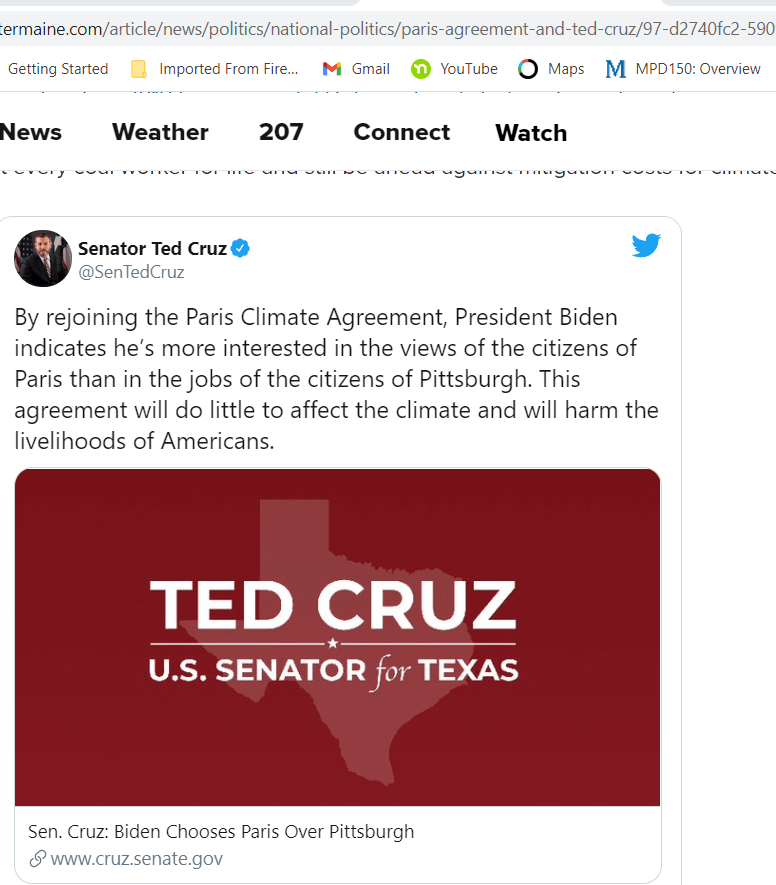
Also, as I write, the newly sworn-in President Biden has rejoined the Paris Climate Accords, which T., his predecessor, had gleefully walked out of. Despite what seriously misinformed Sen, Ted Cruz thinks the Accords are all about, worldwide unity and action to mitigate the oncoming real disasters is what it will take to address this worldwide phenomenon.
Little Aruba is not satisfied with being self-sufficient in clean water. In 2012 at the Rio+20 United Nations Conference on Sustainable Development, the island announced its aim to cover its electricity demand by 100% renewable sources by 2020. In the same year, Aruba together with other Caribbean islands became a member of the Carbon War Room’s Ten Island Challenge, an initiative launched at the Rio +20 Conference aiming for islands to shift towards 100% renewable energy. In 2020, they are a long way from 100% (15.4%), but at least they are measuring. The website showing the 100% Renewable Energy Atlas shows progress by country, region, or city vs. goal.
P.S. There are giant poisonous centipedes in the Arikok National Park. Stay away from them.
 Other states, other lives, other souls
Thanks, Carol, I like this! But not the poisonous centipede.
On Thu, Jan 21, 2021 at 7:35 PM Other states, other lives, other souls wrote:
> carolcwhite posted: ” (Note: Readers familiar with my travel blog will > know that I try not to describe the obvious about places I have traveled. > How many ways can I talk about white sand, sun and wind? All good, but you > can learn that anywhere.} A few mon” >
LikeLike
Very interesting, but the centipede warning threw me.
LikeLike
See my Facebook post about my encounter with one in Arikok National park. No worries anywhere else.
LikeLike