In late winter of 1992 an old friend invited me to join her and two other women on a week-long trip down the Quintana Roo coast to the Biosphere called Sian Ka’an, or “origin of the sky”, by the Mayans. In 1986 it was designated a Biosphere and in 1987 a World Heritage Site. I joined at the last minute and left all the planning to the other three. 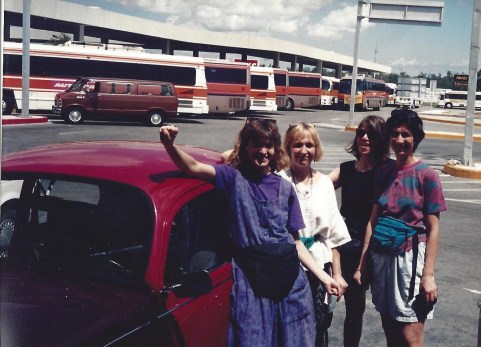 We flew into Cancun and rented a car. It was a red VW Beatle. I have since read more recent blogs that warn: Do not take a private car down the peninsula unless it is 4-wheel drive, because the condition of the only road is so bad. It was bad back in 1992 as well. Besides the generally bumpy ride, there were (are) potholes the size of VW Beatles.
It seems that none of us had done our homework on the biosphere or the weather before arriving. We asked at the entrance gate about getting to Sian Ka’an and the guard with a mixture of gesture, Mayan and Spanish tried to explain, but we weren’t getting it. 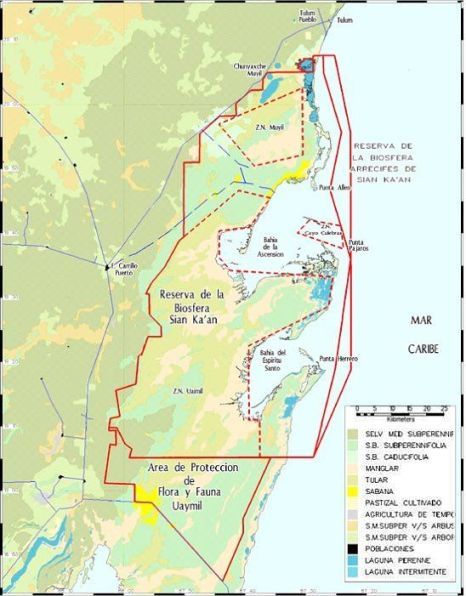 I see now, 18 years later, that the biosphere is a gigantic area of land, only a small part of which is the peninsula ending at Punta Allen. (map). In retrospect I think he was telling us to turn back and take the other road around the other side toward Muyil. We never got there. Instead we bumped our way down the gravel road, watching the Caribbean lap the sandy edges of the narrow peninsula on our left, and the semi-saline lagoons not far away on our right, looking for a place to stay and a boat that would take us down the coast to see the marine life.
There was not much in the way of tourist development back then. We passed several basic beach houses; at least one flew a pirate flag. No stopping for directions there! We finally found a nice row of basic rooms along the palm lined beach front and rented a room with 4 beds for the night. By that time I had lost my reading glasses somewhere on the way down from Cancun. We stopped in the next village to buy another pair. I discovered that traditional Mayans didn’t wear reading glasses. They relied on the blazing sun, I suppose. I had brought the big book about Mayan Culture with me—the one that I bought after the last trip mentioned in Part 1. The Mayan approach worked for me to on the beach but in the darkening room I was blind. I remember one of my friends reading aloud to me for a bit.
The Mayan Riviera in February and March is often very windy. 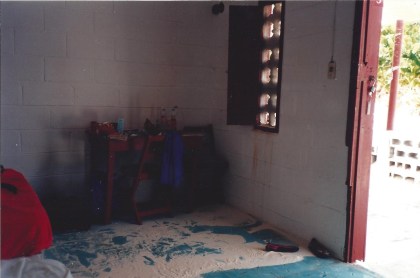 Here is a picture of the inside of our room after a night of crashing waves and serious wind. The next day we set about finding a boatman to take us down the coast. No one would take us because it was too windy. We decided to wait another day for better weather. We beach-bummed it all day, like Canadian tourists in Cancun, watching the skies for pelicans and roseate spoonbills That day we were also refused passage again by the boatmen for the same reason. It was time to give up and head back north.
  On our way back we did manage to find a wonderful, and, at the time, little known cenote near Tulum. A cenote is a sinkhole that reaches into the underground watertable that hides beneath the dry ecosystem of Quintana Roo. Crystal clear water, walls of mangrove roots, and schools of little fishes.
By April of that year it was once again time to take part in our Minneapolis neighborhood May Day pageant put on by Heart of the Beast Puppet Theater.  I decided to create a larger than life Mayan peasant puppet. It was built on a kind of primitive back pack frame so she was taller than me with eye holes in the shawl area. During those years our son was enrolled in Anderson Open K-8 school. Part of “open” meant that parents could put on mini courses on topics they had some expertise in to a small group of kids during the school day. I brazenly designed a week-long daily one-hour class on the Mayans that the students could volunteer for if it interested them. My entrance on the first day of class was an attention grabber because I wore the large Mayan peasant puppet costume. The day’s presentation was mathematics-themed. I talked about how the Mayans had invented the concept of zero and the intricate calendar. I showed a graph comparing various ancient structures in size to Chichen Itza and talked about reading graphs. Sadly, my memory fails me on what else was covered during the week and I didn’t keep the written curriculum. The last day we had a little “Mayan” snack. What I remember most was that one of the children brought in from home a family album. It turned out that she was from Nicaragua and her family had Mayan heritage. She was so proud to share her culture and photos with the other kids. My takeaway was that highlighting in a positive way the cultures represented in a low-income inner-city school can be very meaningful to a child.
Our final trip was in 2004 when my husband Phil and I returned to the peninsula part of Sian Ka’an again–this time with a plan and a guide.


This was a weeklong kayak plus birding trip, with kayaker extraordinaire Gail Green of Living Adventure. It was the same time of year as the last trip. We did not learn our lesson. My Mayan fixation had waned, but my kayak fixation had surged. The trip was supposed to be a combo of easy kayaking in the semi-saline pools, a stay in a lovely lodge (Caphe Ha) on the beach, shared cooking, dawn birding, and learning to kayak into and out of surf. All of it was great, except we were near the end of the trip and we had not gone into the surf because Gail judged it to be too rough for beginners. We were no longer beginners, and we started grumbling and whining that we wanted the surf experience. Gail finally relented and those of us who dared got our lessons. Very thrilling. We did not venture out beyond the surf though because she was right– it was too rough. 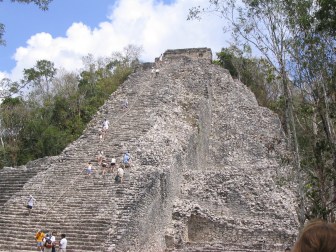 Although this trip was not much about Sian Ka’an, we did get over to the Muyil side after all and see the Mayan ruin. A shout out to Gail Green for her intrepidness. We were not able to see her at her most intrepid on this trip, but we cheered her when one of us dropped their sunglasses into the lagoon. Gail paddled over, glanced down, spun over, picked them up, and righted herself in one smooth motion. She later circumnavigated Lake Baikal by kayak. I guess Lake Superior wasn’t enough for her. Living Adventure finally closed in 2019.


Great reading as always, Carol – thanks so much !
LikeLike