Ed: This is another set of travel reminiscences, during the time of no travel due to the pandemic.
About 35 years ago my husband Phil and I spent a winter vacation with our six-year old daughter in the southeastern Yucatan peninsula of Mexico, the free and sovereign state of Quintana Roo. Mayans currently are about 20% of the population and the Mayan language is still spoken. They are very fond of the letter X (the town Xcaret, for example). They have a 1000-year old history in the state that includes quite a bit of warfare and shifting alliances, with a collapse of many of the great cities by 900 AD. Since then I have returned to Mayan country four more times, on road trips, island hopping, two trips to the Mayan bio-reserve, and once to Belize. This post will cover the first two trips.
Our first trip was to Cancun which at that time was not the Anglo-occupied tourist ruin that it is now. It has been loved to death and the golden egg was killed long ago through over-development and pollution. We stayed at a small Mexican-owned hotel called Flamboyanes (Flame tree) in town. It had a pool, lots of flowering shrubs and a quicky mart on the premises. 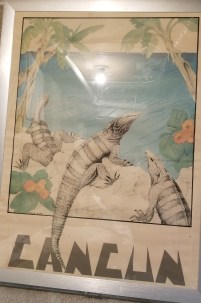 We chose Cancun because we knew a woman from Minnesota who had relocated to Cancun after her husband died. She was an artist and had secured a commission to make travel posters for the city while learning to scuba dive.
 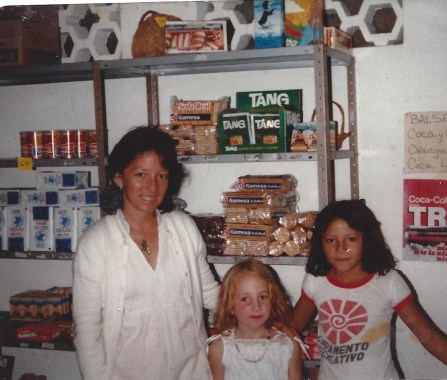 Our daughter very quickly made friends with the hotel owner family, as she frequented the quicky mart for treats. They asked if she could visit their home on Saturday and we said yes. When she got back I asked what she had done there. She said she watched the Smurfs in Spanish (which she did not speak, but no problem).
As often happens on trips that are self-planned, we met up with another American family with a girl Jesse’s age. Let’s rent a car together, we said, and visit some of the ruins. That was our first trip to Tulum, a Mayan and Toltec trading center for a thousand years. Tulum is now ruined by rich white people, who should be stripped naked and forced to run through the jungle pursued by jaguars (not the cars they drive). Now tourists can no longer climb the small pyramid since it is alleged Justin Bieber peed on it. Another reason we hate Justin Bieber.
Next the three of us took the ferry to Isla Mujeres from Puerto Juarez. Isla was a very sleepy place then with a lovely small un-ruined reef. Winter is very windy in the Caribbean and I was certain on the trip back that our small ferry would tip over and drown us. Little Jess, in a bit of foreshadowing, seemed unfazed by it all. She has become a water baby, confident of her ability to plumb whatever depths of ocean water she encounters.
Our second trip to Quintana Roo was 8 years later. Jesse was then fourteen and baby Louis, who we had left behind with Phil’s sister before, was 8. We skipped Cancun, rented a car and started our road trip, which included a near death experience on the highway to Puerto Juarez. Some tourists warned “never drive in Mexico; it’s not safe, especially at night.” We ignored that advice and, sure enough, it was not safe. We were cruising along happily with the windows open when Phil looked down and saw a large bee that had landed between his legs. As he was allergic to bee stings, he panicked, forgot to look at the road and began beating away the creature. I yelled and he suddenly looked up as we were about to head into an oncoming car. Swerve!!
Puerto Juarez was our first stop again on the road trip to ferry us back to Isla Mujeres. Isla, by this time, was overrun by feral small dogs that could be seen from any hotel window on rooftops below. There had recently been a dog curfew declared (dog lover trigger warning), threatening that any dogs left out and unclaimed would be put down. The island was busier by then; nearby the hotel were small motor scooters for rent to take out of town on the quiet roads. Jesse begged us to let her rent one and, against our better judgment, we finally said yes. She took Louis along in the back. A half hour later she came back sheepishly, having returned the bike, and with a large road burn on her calf. Louis was fine. The reef by now was less pristine, due to crowds smeared with sunscreen wading out for a look. Locals pleaded with tourists to wash it off before entering the water. The highlight of the trip this time was a trip to Contoy (Bird) Island on a small motorized fishing craft with a local guy and two young helpers. It was a bumpy ride with a stop at a deep reef along the way where one could encounter nurse sharks below while snorkeling above. None of us got sea sick, luckily, which was not true of one of the women I was with on a repeat trip several years later. I see now that the Island is still protected and not ruined by tourists. Yay! On the way our hosts fished for lunch, made lunch for us on the beach, let us bask a while and see all the birds and head back. On the way we saw two rays with eight-foot wing spans breach the water completely and settle back down beneath the waves.
Our third stop was at Chichen Itza, the already famous and magnificent 1500-year old Mayan City and ruins on the way to Mérida, the capital of the state of Yucatan. It is full of beautiful bas relief stone carvings. The ancient Mayans were known for their astronomical and mathematical prowess. It’s pyramid Castillo is an example in its design:
As the spring or fall equinox sun sets, a play of light and shadow creates the appearance of a snake that gradually undulates down the stairway of the pyramid. This diamond-backed snake is composed of seven or so triangular shadows, cast by the stepped terraces of the pyramid. The sinking sun seems to give life to the sinuous shadows, which make a decidedly snaky pattern on their way down the stairs.(http://www.exploratorium.edu/ancientobs/chichen/HTML/castillo.html)
You can see it in action here: http://www.youtube.com/watch?v=Zvv9EnBuem4
I had come prepared to make what turned out to be an embarrassing cultural mistake. I thought it would be great to make a crayon rubbing of one of the carvings to take home. I had just begun when a tour guide started yelling and running over to me. Of course, that activity was very much forbidden. Not only was I disrespecting an ancient masterpiece (which I was), but I later saw I was depriving a local guy of selling me one already made in one of the little shops outside the main entrance. I am still chastened when I think of it 27 years later.
Our fourth stop was in Mérida, which is a 500-year old Spanish colonial and Mayan-influenced city. We stayed in a very old hotel with a central courtyard for air conditioning and no electricity in the ensuite bathroom. The children were very frightened of the toilet, because they couldn’t see well, there were likely large bugs on the wall, and there was no toilet seat. Nevertheless, it was magical to me and quite cool, despite the 100-degree temps. We walked around blocks of indigenous-run small shops, where I learned that it was popular to make brooches out of live colorful bejeweled cockroaches. There was a bowlful in one shop, which I passed on. Come nightfall we took a horse drawn carriage through the Spanish side of town with narrow tree-lined streets and palatial homes. All in all, a very romantic and interesting city,
Our fifth stop was supposed to be at a hotel near another newly uncovered Mayan ruin. We found it was closed so we high-tailed it to the Mayan Riviera and drove into the nearest fancy condo area in the dark. A Mexican man with no uniform motioned to us that he had a place we could stay for only $100. Time for trust. It seemed luxe, but was a silk purse in several ways we found out later.
We next drove off for dinner at a close-by palapa seafood restaurant along the road near Xcaret. The food was fresh and excellent. Jesse was enjoying the cold cooked shrimp until her lips started to swell and her throat tickle. Panic time, since this was a new allergy and she had no inhaler at the time. We hurried back to the condo and I began getting Jesse to drink lots of water and started putting cold, wet paper towels on the hives on her arms. This actually worked and her reaction gradually lessened.
Our last stop was the town of Playa del Carmen, a sleepy hippie town on the beach with simple places one could rent for a pittance to sleep the night in a hammock in a closed room.  It was there that Louis learned to love the international currency—a box of Pringles. And Jesse learned that there were cute hippie jewelry sellers and cans of tuna fish that could keep her happy and entertained during her “I could care less” period. From there we took the ferry to the large developed island of Cozumel, to meet up with some old friends who were there for a few days on release from a cruise their mother was paying for. Free space at the hotel and a dip in the sea. The hotel sported a sea wall with a ladder so one could lower themselves down to snorkel, float along with the current to the next ladder and arise from the sea to land. Louis had on his snorkel equipment and climbed down. When he popped back up to the next ladder he exclaimed “Now I now why they call it the beauty of the sea!” He’s always been an emotive child.
 We returned home and I bought a huge book on the history of the Mayans and put up on the wall a mystical carved cedar Mayan-style head, made for the tourist industry. I still have it, but it has lost its snake tongue.
Just recently a new high end Mexican restaurant opened up in Minneapolis called Popul Vuh. Not sure if this was a clear case of cultural appropriation, like calling a hamburger joint the Old Testament, but the food was sensational.
 Other states, other lives, other souls
Thanks for this. It brought back memories of the six trips with elementary school-aged Sam to the region in quest of Mayan temples in then out-of-the-way areas. We rode buses, walked, and once hitched a ride in the back of a pickup on a load of fruit. The comments re: rich white people pursued by jaguars and Bieber-hatred had me howling!
LikeLiked by 1 person
how many kids ? Six! Wow!
LikeLiked by 1 person
so great to read this and have great memories! The tuna fish eating strategy, however, began on Isla!
LikeLiked by 1 person
It’s called creative nonfiction. Phil thinks the bee episode happened in France!
LikeLiked by 1 person