On our fourth week of March in Colombia we headed for a pre-planned trip into the part of the Andes called Los Nevados National Park. About 8 hours by bus from Medellin toward the west, Los Nevados consists of mountain peaks of up to 17,000 feet, glaciers, volcanos, and a wide array of ecological regions. My husband worked through an international travel-arranging company called Kim Kim. He agreed to a four-day mountain exploration consisting of one day of downhill mountain-biking, one day of climbing up to the bottom of a glacier, and two days of hiking essentially down the southern side of the park, from 13,000+ feet to the town of Pereira at 4600 feet; all of this with a local guide. My husband trimmed the five-day package to four in order to accommodate me, a less fit hiker of 73 years. We took a spin class before leaving, since in winter we generally don’t bike, and practiced walking on inclines and doing the usual weight training on legs, back, arms, and balance. We live at 830 feet altitude, so that part we could not prep for, except by leaving the big mountains until the last week, and spending three weeks at 5000 to 8000 feet altitude in other parts of Colombia.
As can happen when trying out new experiences, our expectations were not always right. Doing things at 12,000 feet in conditions that were difficult at best and frightening at worst can lead to panic, which is not a good thing. This post is about avoiding panic in tough situations. Here is what happened.
First, before we even set out on the Los Nevados trip, I discovered that I had miscounted my blood pressure pills and I was 10 days short. Rising panic. Our Colombian daughter-in-law assured us that we could probably find them at the pharmacy and buy without a prescription. Before doing that, I noticed that my husband’s BP med had the same base generic name as mine SARTAN, in the ARB category. I checked on the web whether there was equivalence between the two. There was. Instead of the time spent hunting for my medication in small town pharmacies, while contemplating my imminent MI, I just started taking his pills. No problem. If your blood pressure without medication is quite high, a call to your doctor is probably warranted.
 The mountain biking was great. We started at the park office on the northern side called Brises. It sits at 13,000 feet and marks the start of the páramo, a high plains subtropical region that exists between the tree line and the frost line in tropical Latin and Central America. It was cold! But soon we were shedding clothing as we headed down the mountain for a total of five hours.

We stopped halfway at a thermal bath called Thermales de Ruiz for stroll, a soak, and lunch. Magical. The road was often rocky and gravelled, but not difficult. At the end of the second half, we hit a smooth curvy road with very few cars and we sped joyously down to 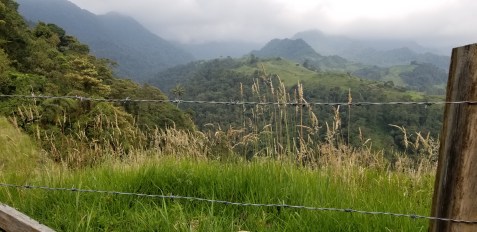 just outside Manizales city at about 7000 feet.
Day two began the hiking part. March in Colombia is the start of a rainy season. We were dropped off by a four-wheel drive vehicle at Nevado de Santa Isabel, a starting point at 13,000 feet for reaching the Santa Isabel glacier’s base at 15,500. Colombia’s glaciers are receding rapidly due to global warming, having lost 90% of their original size.

As we trudged up the steep path at about 10:30 in the morning, we passed two young men and their guide coming down, who had started the same climb at 4 am and had roped all the way up to the summit. Ah, youth! Looking up toward the ridge where the glacier could be seen and touched if we reached it, we saw increasing cloud cover. Then it began to hail lightly. At altitude, my symptoms were breathlessness. Every 50 feet or so I stopped to get my heart rate down and then proceeded. Phil’s symptoms were dizziness and nausea. As long as he didn’t move his head, he could cope. Our young guide was very encouraging, saying that often his younger invincible climbers were vomiting. After 90 minutes of increasing cloud cover, cold, and light hail, we called it quits and headed downhill to the starting point. Our driver picked us up and we stopped for lunch before heading up to our first night at a simple farm called Campoalegre at 12,800 feet, just outside the park.
The next two days we would be walking down toward the south for 25 miles. Campoalegre was a pretty threadbare farm, with up to three bunk beds, mattresses, and a pile of blankets per room. No heat, no hot water and no toilet seats. We put on every warm bit of clothing we brought and I added a blanket serape besides. Our guide boiled ginger tea for us on his little camp stove. Dinner was fine, but after chatting a bit with two Danish girls and a German boy, we were ready to cuddle up to read for the night in our sleeping bags plus blankets. Lights out and then the trouble began: breathing, while lying down at 12k plus. I practiced my slow deep breathing, but it didn’t help much. I started to get that panicky feeling that comes with an asthma attack. I hit my inhaler one last time. I don’t remember sleeping at all, but I “rested” for 8 hours. We breakfasted at 6 am to be on the road by 6:30. Our guide optimistically said it would be about 20K, starting with a gradual uphill on a dirt road for 6k and then onto a trail through the páramo for 8k, and ending with 6k more down a steep rocky path to our second farmhouse for the night. That was more than I have walked in one day in a long time. No choice but to proceed on.
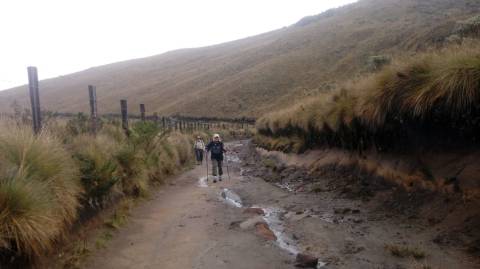
The first leg of the stool was fine, but slow. Cloudy, chilly, but a mystical cloudy. We then turned onto the second leg, the path. It was cut through into a muddy channel about 1 foot deep and 16 inches wide by horses and mules, with tuffets of grass to hop onto as possible.

The páramo is so unusual that it distracted us from the increasing fatigue for a while. There were periods of drizzle, but no serious rain. We passed by a lovely pale blue Lake Otún below us, but no time to dawdle. At about 9 or 10 miles Fredy the guide prepared to cook us a nice lunch before completing the hike; we demurred, in favor of snacks and water and a sit down, so as not to end up possibly hiking in the dusk. He agreed we were behind schedule.
After lunch the serious work began, the third leg. The steep downhill was an ancient river bed from glacier days. It was boulder-strewn, very steep, and wet or muddy. We struggled to watch our footing, but not take too much time. After a while, my legs were heavy and I stumbled more often than was good. Pretty soon my left knee started to swell from twisting and coming down hard from boulder to boulder. I was afraid it would lead to an injury that would take months to recover. But what could be done? The only way down was by foot or horse, and the only path was the one we were on. I said “I don’t think I can do this again tomorrow.” Helicopter? Skyhook? The sky was a white screen. We finally came to an area with cows and a view of the valley. Was this the end? No! It soon led to another abyss with an opaque future, and more vertical cows.
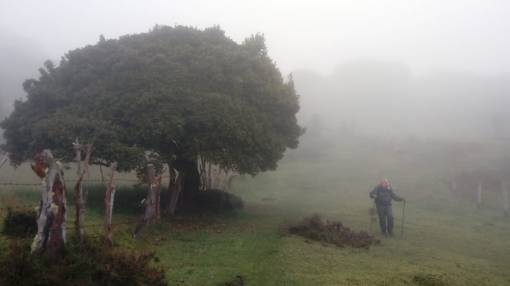
After several of these natural bait-and-switches Fredy decided to take us on a shortcut down through the steep cow pasture. This was equally challenging footing, but a fall would be onto grass, likely, rather than a boulder. When I had stopped thinking we might be near the valley floor, Fredy led us back over the barbed wire fencing to continue down the boulder field. But, abruptly, he reached a gate, opened it, and there we were—at the Jordan farmstead—after 22k and 11 hours of hiking.


This place was a self-reliant farm whose meager income was supplemented by taking in hikers. The family had inherited the land from previous generations. No roads, no boats. The only way to town to buy groceries or sell milk was to take the same steep trail we had just left, either by foot or horse.

They had electricity, plumbing, but no hot water or heat. Most cooking was done on a large wood stove, which also served as a source of heat for drying clothes and wet shoes. We guests were invited to sit in the kitchen on little chairs to enjoy a home cooked traditional meal which we watched Mary Luz cook.
At this lower altitude, we enjoyed slightly warmer temperatures and a good night’s sleep. I was dreading the next day’s hike down of 16K. I was surprised to find out that Fredy had arranged with the farmer, Mario, to lead me down by horse in the morning.
 The next morning I watched as Mario brought down from his pasture two horses, one saddled and one not. I was very nervous imagining how I would stay on the horse on the steep rocky inclines. Luckily, I am generally fond of horses and have ridden them from time to time, even taking English-style riding lessons in college. The last time I rode was three summers ago, for a brief time in Iceland. But never, in these conditions.
 The riders among the group signaled to me how important it was on the steep rocky downhills to lean as far back as possible, so as not to plunge off the front of the horse. No helmet, so a fall on my head would probably kill me.
 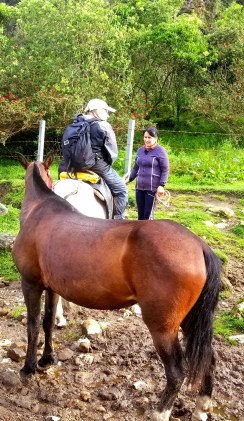 Due to the language barrier, I only gradually became aware that Mario was not riding the second horse, but leading mine and the second horse with a long rope from the front, on foot. My job was to hold onto the horn and grip like mad with my knees. There are no pictures because no one was with us and I certainly was not going to let go of the horn to snap a selfie! In searching for a picture on Google of the lean-back position, I found several experts who advised not to lean back because it would put too much pressure on the spine of the horse. However, none of them show them riding down the amount of incline we were negotiating, and I followed the visual guidance Mario was giving me. At first I was panicky about my ability to stay put for the three to four hours it would take to go 16K. How could I grip with my knees for that long? My hands would be killing me gripping the horn that hard. Not long after we began, Mario showed me where I could grab hold of a strap in the back as well as the horn. With that three-point hold (horn, knee grip and back strap), I felt much more secure and I began to relax into the ordeal. It felt like a rappelling position, which I had experienced once on an earlier trip in Colombia. Except for a couple of K where I dismounted to walk down at the steepest section, I rode all the way down with no stopping for the 3.5 hours it took to get to the bottom. I felt amazingly comfortable in the padded saddle and able to continue knee gripping. I was able to enjoy the amazing surroundings of waterfalls, jungle, birds and vertical pasture, which I could not do while picking my way on foot, as I had the day before.
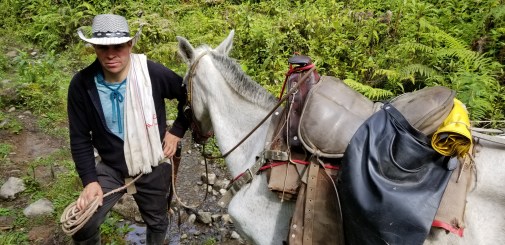
I watched Mario as he deftly and swiftly picked his way down in knee-high rubber boots, occasionally slipping, but unafraid. He guided the horses toward the best ways down, but occasionally my horse chose a slightly different route. All good. The horse tripped a few times, but never enough to throw me off. So practiced was Mario that he got us down in half the time it took my husband and Fredy to walk down. I worried that they would be very anxious about my safety, but there was no way to communicate with them that all was well. When I connected back up with them at the little resto at the bottom, I was somewhat relieved that at some point they encountered hikers we had passed on their way up. They asked about me and was told that I looked happy. I was.
At the bottom I offered Mario a beverage or something, but he said no. Off he went, after saddling the second horse, to lead four young children on the two horses with their walking parents back up the mountain to an ecological sanctuary called La Pastora.
That night at the hotel in Pereira, Phil and I looked like a couple of rest home escapees–he, with screaming calves and I, with screaming thighs– tottering up the four flights of stairs to the roof bar for dinner.


Good story to share. We can have our challenges at any age, too!
LikeLike
Only wish you would write up some of yours.
LikeLike
Very glad you survived and even enjoyed much of your ordeal. It sounds like, when you have to, you can depend on the mercies of strangers in that part of Colombia.
LikeLike
Yes. We paid him too.
LikeLike
Wow, I’m impressed with your spirit of adventure and with your honesty. I had a similar feeling while climbing all of the stairs in Sicily. Thank goodness for Ibuprophen!
LikeLike
I’m interested in what my red blood cell count will look like for my annual physical exam tomorrow–all that high altitude exercise.
LikeLike
Hi Carol, my happy birthday (2021) post to you – went through the archives a bit and was reminded of this story, such a great example of your courageous get-on-with-it traveler’s attitude! Looking forward to some adventure in Mexico. Here’s to a great, COVID-free, year ahead! xoxo
LikeLike
Me too. I spoke to my sister today and she might be interested in spending some time in Merida with us. That extra bedroom? Maybe 10 days. What do you think?
LikeLike
Me too. My sister might be interested in joining us for the last part of January. Is that OK? (no more than 10 days)
LikeLike