Preface: This is Part two of places we can’t visit right now, due to the coronavirus pandemic, but maybe later.
In summer of 2006 and 2007, my husband and I went on holiday to southwestern France, to a little town at the foot of the Pyrenees called Plaisance. A colleague had put up her former miners’ row house in Plaisance for bid as part of an auction benefit for the Center for Victims of Torture. Avid Francophiles, we won the bid and were allowed to stay two years in a row. Who knew there was so much open space in France? But that is a story for another day.
The first year we picked up our daughter and her Wheaton terrier in Amsterdam, on break from graduate school in the Hague. We took the dog-friendly section of the bullet train to Beziers and then rented a car to drive up the mountain to Plaisance. We were so taken by the sleepy beauty of the place and the nearby places to walk, drive or bike to, we signed up for a second year.
This time, without our daughter who was done with school, we opted to fly into Barcelona as the jumping off point. We rented a car in Spain for the ten days to get us across to France and up the mountain, and we took a friend and my sister along. We decided to spend three days in Barcelona–1 before leaving for Plaisance and 2 on our way back, before flying back to Minnesota.
Part 2
One advantage of a travel blog is having time to find out more detail about places I have visited, sometimes without time to really reach the top of Plato’s cave. The cave metaphor might apply to visiting Barcelona for only three days. Yes, the sun was blinding in summer, but the food was delicious and fresh in the market, so we were off to see what Barcelona had to offer with no hesitancy.
Catalan district is millennia old and has been semi-independent from Spain since 1979. Barcelona is its capital. The independence movement has waxed and waned over the last few centuries, but right now it is pretty strong. The region has its own language, Catalan, but you will do fine with some Spanish or Google translate.
In the late 19th Century, Barcelona became an industrial powerhouse and as it grew untended, the cultural leaders of the city decided to create conditions for a special Catalan aesthetic and culture dubbed Catalan Modernisme, influenced by the Art Nouveau movement.
If each architect developed their own particular style, some common traits of Catalan modernism include a preference for asymmetrical shapes and those which replicate the natural world; curved lines are preferred to straight lines. Nature, too, is a source of inspiration in terms of the themes which can be found in the details of facades, murals and features such as windows and balconies: leaves, trees, flowers and animals are most common. Altogether, Modernisme is highly ornate, with much focus on aesthetic details. https://theculturetrip.com/europe/spain/articles/what-is-catalan-modernism-and-why-is-barcelona-so-famous-for-it/
Antoni Gaudi is Modernisme’s most famous representative. He specialized in outdoor, giant mosaics. It seemed like a good choice for my travel reminiscence this week because I am an amateur mosaicist, with emphasis on AMATEUR. 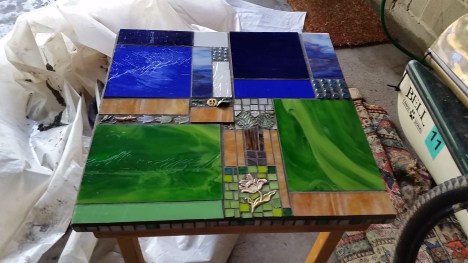 We just uncovered the outdoor cedar table with my mosaic abstract landscape top that stayed outside on our deck all winter for the first time. When my husband picked it up to move it back to the right spot, the whole mesh frame holding it together started to slip off and I realized that the glue and the grout hadn’t made it through the cold. I have a lot to learn!
I recommend three places to visit, two with Gaudi work, and one with amazing views, in Barcelona. The first, obviously, is Sagrada Familia, the Catholic Church that has been under construction for 100 years.
Gaudi used to sleep in the church, so obsessed with the project was he. When it opens again, go early or check out the tickets in advance.
 The second is Casa Batllo, or House of Bones. It was redesigned by Gaudi in 1906. It was owned by industrialist Josep Batllo who wanted a showpiece and something unlike any other house in the prosperous area. It amazes me that an industrialist 115 years ago wanted a home so unusual. In the US the homes of the ultra-wealthy are usually traditional or gaudy, not Gaudi. They compete on size, location, and cost of the furnishings. Our current president, the real estate mogul, wants gold fixtures and golf courses and his name in giant Ariel font letters on the front. His recent pronouncement in February 2020 about “making federal buildings beautiful again” defined beautiful as the style of Greek autocrats 2000 years ago. Surprised?
There are Art Nouveau buildings in Chicago, New York City and Los Angeles, but in my brief research they were mostly public buildings and homes much more traditional in appearance with Art Nouveau touches.
The third area is the Tibidabo Amusement Park, up the mountain from the main city center. It is the oldest operating amusement park in Spain, opened in 1905.


In 2007 we got there by means of a funicular, a closed rail carriage rising steeply from the floor of the city, but that no longer seems to be in existence. There are a cable car and express buses. We didn’t take any of the rides that fly out over the cliff, but the views were terrific. The shots we have show an unclear sky. I wonder how it looks now with the big drop in vehicular traffic. I found this comparison. Scroll down to see the Barcelona examples.
Let me end this post with a song you probably know, that was created to advertise the funicular railway in Spain. I bet many of you can sing along: www.youtube.com/watch?v=XaO1GrltxwM
 Other states, other lives, other souls