Note: I read somewhere recently that while most of the world right now is not able to travel anywhere for pleasure, it is a good practice during confinement to go over old pictures of previous travel and reminisce. This is Part 1 of that process, which I am sharing with the reader. It was inspired by a recent article about Amsterdam without tourists due to the coronavirus precautions as well as thoughts of my mother as Mother’s Day approaches this Sunday.
My mother was 100% Dutch, but born in the USA. We lived in Illinois in the post WWII era when foreign travel was rare, even among the well off. Our vacations consisted of a week at a resort in Wisconsin in the summer or a quick drive down to bake on the Florida beaches during spring break. But, perhaps because of my mother’s origins, she made a practice of collecting travel brochures. A gal can dream, no?
The Dutch have been and are still known as avid travelers. According to a Dutch responder on Quora: “I also believe that travelling is in our DNA. The Dutch have been travelers for centuries now. From around 1600 until 1700 can be marked as our Golden Age period which brought our tiny country lots of prosperity. The Dutch were (and still are) good traders and they traveled the world and the seven seas to find tradable goods, sugar, shells, people, you name it.” (www.quora.com/Why-do-Dutch-people-travel-so-much)
I recall meeting a Dutchman on a flight from Amsterdam to Guinea in West Africa in August of 2003. I asked him why he was traveling and he said that he brought fabric dyes from Holland to the markets in Conakry, the capital. After landing he broke down the large quantities into smaller bags of dye for small-scale sellers. Beautiful undyed textured fabrics are created in factories in the UK and sent to West Africa to be turned into gloriously colored solid and patterned cloth by the locals. Later I bought a set of patterned and solid blue matching cloth in the market in Kenema, Sierra Leone. In less than a week it was made into a skirt (pattern), blouse (solid), and little string purse by Mohamed using a treadle sewing machine. International trade at its most basic.
After we children were grown and gone and my mother was divorced, she began a little international travel beyond Canada, where a passport was not required. She needed a passport for the group trip to Scandinavia she had signed up for. When she requested a copy of her birth certificate from the county registrar she was shocked to discover that the first name on the certificate was not Hazel, the name she had gone by all her life, but Harriet. Too late to change at 70 years old.
By the year 2000 my husband and I were making good money. I decided that for my mother’s 80th birthday I would take her on a trip to Amsterdam, her first trip to the country of her origins. I call it a Dutch treat, so to speak, although the actual meaning of Dutch Treat is when each person pays their own way. I just learned from Wikipedia that the negative origins of Dutch treat date back to the 17th Century, when the Anglo-Dutch wars over trade and control of the seas took place. The concept of splitting the tab, apparently, is known throughout Europe and the Middle East, and most often is considered the height of rudeness. I see the idea of splitting something in half in the words Dutch door and double Dutch.
My mother was pleased but asked for a raincheck. At the time she was being treated with Coumedin, a blood thinner given to prevent strokes; the drug required weekly visits to the clinic to make sure the dose and response were right. The trip was postponed almost a year and I made reservations for the first week of October. (cue foreshadowing music) Then 9/11 happened. Planes in the US were grounded for a week. I asked my mother if she wanted to cancel the trip. “No! I could die any day, anyway.” So off we went.
I had envisioned biking through the streets of Amsterdam together, as my mother-even at 80-continued to ride her bike around the neighborhood. She took one look at the superhighway of bicyclists in the city and said no way. Walking was ok though. We were lodged in a typical three storey canal house hotel, on the edge of the red light district and the Nieuwmarkt Square. Our room was at the top of a narrow circular stairway. All very 17th Century. I dragged our two suitcases up and my mother, who walked the stairs to her bedroom until six months before she died, trudged up without complaint. I also learned from Quora that not complaining and criticizing those who do is also a very Dutch thing. On Saturday we wandered over to the flower market at Nieuwmarkt and bought a huge bouquet of sunflowers that we kept in our room for the week.  I have a lovely memory of Hazel/Harriet holding the flowers on the bridge over the canal. Thanks to fear of terrorism, Amsterdam was not filled with throngs of tourists and loutish British school boys on a naughty lark. Walking was very pleasant and we were in the central city. The pier to take a boat ride through the exurban canals and quaint villages was a short walk away. We arrived home safe and sound.
By 2003 my mother started to fade quickly. I described some of the unhappy details in the post I wrote shortly after the 11 day trek I co-organized through Holland in 2015. I started flying down or driving down to Aurora to accompany her to tests and interviews with helpers and hospice staff. Since she had lost the ability to speak, she sent me chatty emails, mixing the cheerful and the dreadful in equal parts. Another Dutch trait, I am told–being blunt and matter-of-fact. 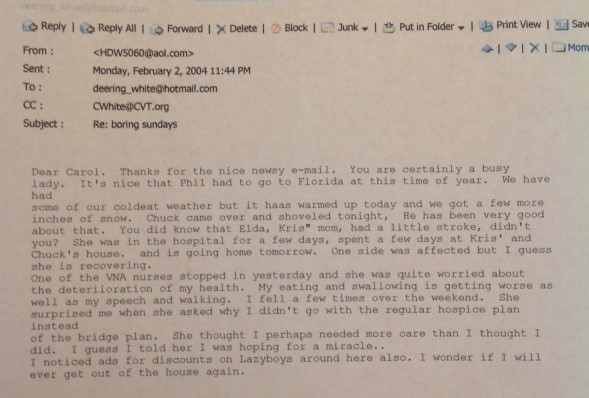
In May 2004 she decided to call it quits, removing the feeding tube. In one week, seemingly without much pain or complaint, with her children around her, she passed on. We had her body cremated, as she requested, and I took her urn back to Minnesota after the funeral. What to do with the ashes? I had a brainstorm. My mother always loved lake swimming. When we owned a simple cabin in Wisconsin in the 90’s, she would drive up and float happily in an inner tube on our quiet, deep Big Sand Lake. I invited my sibs to come up to Minneapolis and we boated out with the urn to the middle of the lake near our house at the time. As we released her ashes slowly into Lake HARRIET, we could see a cloud dispersing into the clear water like a soul joining the universe of atoms that would recycle endlessly back to future souls. Happy Mother’s Day.
 Other states, other lives, other souls
Nice, Carol.
M.
Sent from my iPhone
>
LikeLiked by 1 person