I, like most of you readers right now, am “sheltering in place” for some time because of the coronavirus pandemic. For my husband Phil and me it’s been 2 weeks since we abruptly aborted our planned one-month road trip and drove back home to Minneapolis. Since we are over 65, our children worry about us becoming infected by them or the grands, so one of our main raisons d’etre is being challenged. Life has slowed down and we have had to rearrange our lives to fit the new constraints. Making face masks from old tee shirts and filter material bought through Amazon; cooking blueberry pie with the quarts of frozen berries we bought at Costco for the trip; baking morning glory muffins to share with our elderly neighbors, attending virtual happy hours, classes, and meetings; germinating seeds in the laundry room for our vegetable garden. There will be no travel for a while; no one knows exactly when the curve will be declared adequately flattened. As a result this post will be about conceptual travel—to the Republic of Heaven.
Normally my entertainment reading goes on from 11 to 11:15 pm or 4 to 4:30 am, as a natural sleep inducer. Recently I have taken up reading upright, sitting in our chaise lounge in the bedroom and looking out at the slowly melting deck. This morning I finally finished a long book that I have been reading on and off for months. Titled Daemon Voices, it’s an anthology of lectures and essays on the art of stories and storytelling by Philip Pullman, published in 2018. Pullman is the author of the young adult trilogy His Dark Materials. These fantasy novels create an alternate to the biblical mythology of creation, heaven and hell, daemons and devils, and life after death. For those uninterested in philosophy, eschatology, theology and the like, it’s just a fabulous adventure. The Catholic hierarchy is quite aware of it, however, and Pullman quotes a review of His Dark Materials in the Catholic Herald that the book was “far more worthy of the bonfire than Harry” [Potter] and “a million times more sinister.”
Pullman is an open-minded atheist, fully aware of how important religious belief is to humankind. The last chapter of Daemon Voices is a lecture given in 2000 entitled “The Republic of Heaven: God is dead, long live the Republic! (Making a case for a “Republic of Heaven” on earth, and drawing on children’s literature for signs of what it might look like)”. Pullman opines:
“So it’s nothing new to say that God is dead. I take it that he is, and that since there is no king any more, there is no Kingdom either; but that we need heaven nonetheless. I’m proposing that we look for evidence of a Republic of Heaven…” [on Earth].
Pullman’s characteristics of the Republic of Heaven are those that provide the elements humans need– to feel joy, meaning, connection to a wider universe, the sense that we belong and matter, the sense that our actions make a difference, and a moral compass. Religions, particularly their fundamentalist versions, often try to provide those as well, but at a cost in terms of dogmatism, rejection of science, blind obedience to authority, patriarchy, exclusion, disinterest in improving life on earth, and an eschatology that makes no sense.
Pullman specifically calls out the form of wider meaningfulness that is our connection to nature. Many of us in the modern era have developed what some call a nature deficit disorder, particularly in urbanized areas, from lack of contact with the outdoors and the need to be 3constantly busy. Pullman suggests that the Republic of Heaven can be felt when we are able to see the world as a place of infinite delight. How is this achieved? Sometimes it takes a “stepping aside from habit”. Pullman quotes William Blake, whom he calls one of the founding fathers of the Republic of Heaven: “If the doors of perception were cleansed everything would appear to man as it is, infinite.”
Well, this worldwide pandemic has certainly caused a massive stepping away from habit for all but the most empty-headed among us. My friends and I have started our solitary or socially-distanced walks. Without companions we spend more time looking around us, spotting tiny signs of spring, woodpeckers, and the slow recession of ice on the Minnesota lakes. 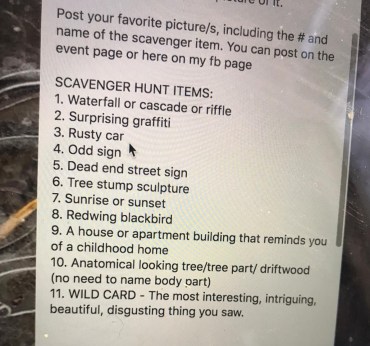 One of our friends organized a nature solo scavenger hunt. On the following Sunday we were directed to take a walk to find any of these objects:
We would take a picture of said item and upload it to a joint What’s App group. Many people jumped right in. Some examples are below. You can assign a number to each one.


Now we are beginning to see many more people out on walks in ones and twos. I hope they are also experiencing a bit of the infinite. Yesterday in a walk through our local park/golf course, we passed by three young adults also on a walk. I asked them “Can I ask you a question? I’m taking an informal survey” Nods. “Would you say you are walking around outside more now that things have changed so much?” Two of three said yes. The one carrying a skateboard said no. One woman said she had typically been outside only going from school to home to work, from the car. She suffers from anxiety and she noticed she feels calmer. Since my husband also suffers from seasonal anxiety, we had a short but meaningful conversation about our histories and how we have dealt with it. Total strangers.
One kind of stepping away I would call new artistic constraints. The concept of artistic constraints has long been thought of as a narrowing of limitless options that can spur creativity. Think of Stevie Wonder, Vincent Van Gogh, African-American cuisine, and Billy McLaughlin . Now a chief constraint is the inability for musicians to play together or to play in front of audiences or for visual artists to show their work in museums or galleries. We have seen a flowering of ideas from musicians to continue their art. Last Friday I sat in on a Zoom virtual salon where 3 musicians played from their homes, including my sister. About 30 people watched and there was an opportunity for the audience to ask questions of the musicians. We each donated $30 that would be given to the musicians. Meaning, connection, joy: √√√.
How about that moral compass for the Republic of Heaven? Quoting Pullman again, he says there are a number of agreed-upon principles. “dishonesty is bad and truthfulness is good; selfishness is wrong and generosity is right.” He adds another that is less commonly stated: “..if an action seeks to restrict understanding and put knowledge in chains, then that is bad too.”
I bet we have all witnessed example of selflessness, sharing of resources, gratitude, and concern for others who aren’t even in our family or attend our church. And we have also seen others whose moral compass seems to be broken. Some of them even claim to be Christian leaders. But surely most of us have noticed a glimpse of the Republic of Heaven during these strange times. You can read the whole Pullman essay here.
I welcome any glimpses you can share through the comments section.
 Other states, other lives, other souls