Two of my closest friends in college became Sufis after graduating. This was during a period in the late sixties when religious exploration was at its height, especially religions from the East and Middle East. Famously, Cat Stevens converted to Islam, after several near-death experiences, in 1977. Although I have never been a religious seeker myself, many of us carried around a dog-eared copy of Rumi poetry from that era. I still have mine. Rumi was a Sufi poet in the early 14th Century. The Sufis pursued, like Kabbalah in Judaism, a more direct ecstatic experience of God. Sufism is generally believed to be a more open, mystical version of Islam. They can be Sunni or Shiite. For some fundamentalist, reactionary Islamists, like ISIS, Sufis have been viewed as heretics and infidels and attacked and killed in recent times.
On our trip to Iran in November this year I learned that Iranians of Persian descent revere their ancient poets from this period after the Arab-Muslim conquest of Persia in the 600’s and the Mongol conquest in the 1200’s. Saadi, Rumi and Hafez all wrote ghazals, or mystical love poems, in Persian, but only Saadi and Hafez lived in the city of Shiraz, Iran.


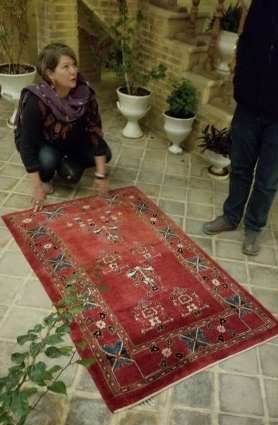
We spent three days in Shiraz, which is the capital of southern Iran and has nearly 2 million people. It also dates back to, perhaps, 2000 BCE. Shiraz has a long history of artistry—inlaid mosaic work, nomadic handmade carpets and kilim rugs, silver ware and literature. While Mohamed drove our small tour bus from amazing site to amazing site, I opened up my Kindle and started to read the story of Hafez in a recent translation by Paul Smith of Hafez’ most famous work the Divan. Up until then I knew nothing about Hafez, except I had happened upon one of his poems in my laptop, not remembering how it got there:
Need
Out
Of a great need
We are all holding hands
And climbing.
Not loving is a letting go.
Listen,
The terrain around here
Is
Far too
Dangerous
For
That.
Hafez has an astonishing life story that Paul Smith recounts at the beginning of his translation. The name he took as his pen name, Hafez, is the title given to someone who has learned the whole Quran by heart. Early on he desired to become a poet like Saadi, but the sudden death of his father caused a drop to poverty and he was forced to leave school and work in a bakery. In his twenties he happened upon an unveiled wealthy young Turkish woman, while delivering bread. Thus began an obsessive romanticization of an untouchable woman. The story goes on to say that Hafez, filled with youthful romantic ardor, decided to take up the mystical challenge by Perfect Master Poet Baba Kuhl to spend forty nights staying awake at his tomb, with the promise of being literally touched by a poetic angel. Hafez succeeded and was visited by the Angel Gabriel, given the water of immortality, and the gift of poetry. So great did he perceive the beauty of the Angel, Hafez began to transform his earthly love into ecstatic love for another greater Beloved—God. Such was his poetic power and the fan base he obtained during his life after that he was able to walk the metaphorical edge of earthly and mystical love in his work, criticize the religious corruption among leaders at the time, and stay alive. I am compressing the story badly for brevity, but, take my word for it, he was an amazing man for his time.
After reading the story, I was psyched to see his tomb in Shiraz. I had also read that Iranians now use his Divan as a way to see their future; kind of like westerners use the I Ching. A person opens the book randomly and selects a ghazal. Inevitably, one sees a personal message in the words. This is often done during the Winter Solstice festival in Iran called Yalda. When we parked the van and got out at Hafez’ tomb, we were instantly met by men carrying small boxes of ghazals. Each man held a captive small bird that was trained to peck out one of the notes to give to the passersby. Probably there was money involved, but we did not take them up on their offers. It was late in the day and the sun was long and yellow across the sky. We walked along a narrow channel and some of us stepped up to the sarcophagus under a domed monument with a splendid ceiling.


A group of local tourists was arranged around it listening to a young man orate some Hafez in a very dramatic voice. When he finished the group applauded and he stepped down and away into the crowd. We walked over to the little gift shop. There a chador-covered woman and her teenage daughter introduced herself, after finding out I was an American tourist. They had come from Kuwait to visit the shrine because her daughter had become a devotee of Hafez. Such is the power of poetry across the centuries.
 Other states, other lives, other souls
Such fun to read info and your reflections on the poetry of the Persians, Carol. It was quite a unique experience being there with you.
Happy travels in 2022.
Marcia
LikeLike