Preface: How many of us have traveled to storied places, like the Egyptian pyramids, the Great Wall of China, the Colosseum, and crossed them off our bucket list, without knowing a lot about their historical or current context? I must admit to some of that when I went to Ephesus in Turkey. Even without much knowledge about why this famous Greek ruin came to exist in Turkey, it was just beautiful and made for some great photos when the light was right.
This happened to me again on our trip to Iran. Three places we visited were unfamiliar to me and though our great guide gave us some information on the fly about them, it left me wanting to know more. One was the tomb of Cyrus the Great, the second was Persepolis, and the third was the tomb of the poet Hafez.
This post focuses on the tomb of Cyrus the Great, his legacy, and his ironic currency in our political environment.
According to Study.com here is the legacy of Cyrus the Great, who is credited with establishing the Persian Empire around 500 BCE.
The Persians were part of a larger migratory group called the Iranians, who moved into modern Iran from southern Russia and central Europe around 1000 B.C.E. The Persians and other Iranian groups eventually formed tribal societies that began expanding their rule over local nomadic tribes. In 550 B.C.E. Cyrus the Great, the leader of the Persians, conquered the Medes and united the Iranian people under one ruler for the first time. Cyrus became the first king of the Persian Empire and went on to establish one of the largest empires in world.
Accomplishments of Cyrus the Great
After unifying the Persians under one ruler, Cyrus and his army set out to win control of the western portion of Iran. This section of Iran included several trade routes that crossed Iran and continued through Anatolia (modern western Turkey). In addition, Cyrus conquered the nomadic tribes who lived in the eastern section of Iran. With the perimeters of his territory secure and the income from the trade routes that he now controlled in western Iran, Cyrus and his generals expanded farther and farther into the lands that neighbored Persia.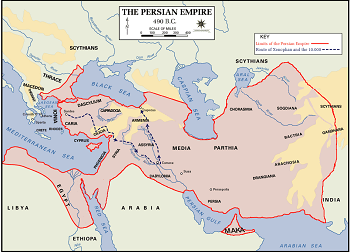
Cyrus and his generals quickly conquered the kingdom of Lydia and Greek cities along the coast of Anatolia, thus gaining access to seaports on the Mediterranean. Unlike many conquerors, Cyrus was a gentle invader. When he conquered the kingdom of Lydia, Cyrus spared the life of the king, Croesus, and Croesus became one of Cyrus’ most valued friends and advisers. Cyrus developed a reputation as a kind and merciful ruler to those that he conquered.
One of the major territories conquered by Cyrus was the Babylonian Kingdom. The Babylonians captured the city of Jerusalem in 587 B.C.E. and forced all the Jewish inhabitants into exile in Babylon. This period of time is called the Babylonian Captivity. When the Jews learned that Cyrus and his army were sweeping towards the kingdom of Babylon, they welcomed them as liberators and assisted Cyrus’ army in overthrowing the Babylonians.
In 538 B.C.E. Cyrus permitted approximately 40,000 Jewish exiles to return to their homes in Jerusalem and ended the Babylonian Captivity. Once they had returned to their homeland, Cyrus used the funds he had acquired in conquering Babylon to rebuild the sacred temple of the Jewish people.
After conquering the Babylonians, Cyrus issued one of the world’s first human rights charters. A cylinder containing this charter was discovered in 1878 during an excavation of ancient Babylon. In this charter, Cyrus promised to treat all the inhabitants of Babylon and the other kingdoms he conquered with respect. He swore that he would allow all inhabitants of his empire to practice their own religious and social customs without persecution. Cyrus also promised to punish anyone who acted cruelly to the religious and social minorities of his kingdom. Cyrus forbade the seizure of farmer’s lands and properties and made slavery of any kind illegal. Cyrus’ commitment to fair and equitable treatment of his people is exemplary by modern standards and was unique during his time period.
This is a pretty great legacy for a conqueror and empire builder living 2500 years ago. Thomas Jefferson was influenced by him in his conception of human rights enshrined in the Declaration of Independence.
Now back to our travel story: Our tour group arrived in Iran on the 30th of October, one day after the unofficial Cyrus the Great Day, commonly celebrated by visiting his tomb near Shiraz. Our group came to know Cyrus as a great guy in Persian history–the George Washington, if you will, of the Persian Empire. To our surprise, he also plays a part now on the world stage in the most recent apocalyptic prophecies of the American Evangelical movement.  Our evangelical Secretary of State, appointed by President Trump after firing the first one, sent a tweet commemorating Cyrus on October 29th.


Since we tourists and plenty of Iranians were visiting his tomb shortly after Cyrus the Great Day, the tweet does seem a bit disingenuous. However this message sounded pretty benign until I found out who this message is really for.
Two questionable religious interest groups have adopted the view promulgated by American Evangelist Franklin Graham that our president Trump has been anointed by God as the second coming of Cyrus the Great! Since Cyrus the Great was not a Christian or a Jew, but a Zoroastrian (or heathen, the term Evangelicals use), the fact that God anointed him (so says Isaiah in the Bible) to save the Jews and reestablish them in Jerusalem makes the myth that Trump with all his imperfections could also be anointed by God plausible in the faithful minds of Biblical fundamentalists. Recently right wing Israeli Prime Minister Netanyahu, who is fighting for his political life due to his indictment on corruption charges, has suggested the same thing. Conflating Trump with Cyrus justifies the recognition of Jerusalem as the Capital of a Jewish State of Israel by Trump and aligns Netanyahu with politically powerful Christian Zionists like Pompeo, who can hardly wait for the End of Days prophesied in Revelations that should follow the return of the Jews to Zion.
Later Sec. Pompeo also cheered on the protests that broke out shortly after we left Iran in response to the sudden dramatic increase in gas prices announced by the Iranian government. In another tweet he asked people to send videos from Iran so that the US could publicize them and hopefully assist in regime change. While we civilians heard plenty of disenchantment with the “Mullahs” from the Iranian strangers we ran into while traveling, we can hardly imagine the Iranian people wanting to submit to the same government that overthrew their first elected government in 1954 and hopes to do the same thing in 2020!
Besides the aforementioned bad actors stirring the pot with their sectarian visions, I discovered another bad actor claiming Cyrus the Great as justification for his own violent apocalyptic fantasy. This piece of investigative journalism follows the strange connections between an Iranian dissident living in Southern California (RESTART), Info wars, QAnon, President Trump and Cyrus the Great. The leader of RESTART in his megalomaniacal website overtly recommends violent acts by the youth of Iran such as burning down banks, killing Revolutionary Guards, and throwing rocks through bank windows. His fantasy is a return to the Persian Empire 2.0, channeling Cyrus the Great for his Make Iran Great Again Crusade. Look at his site and ask yourself if you would buy a used car from this man.
My fellow Americans: How do you feel about your current leaders risking war to help achieve their sectarian religious visions? I don’t like it one bit.
Stay tuned for the next post about the Persian poet Hafez. It’s a much simpler and happier story.
 Other states, other lives, other souls
Thanks, again Carol for a wonderful and engaging post. —Lily
>
LikeLike