Note: This second post about my two week trip to Iran is about my impressions of special rules for women under Islamic law in Iran. I make no claims to be expert in these matters, but since I am female and subject to most of these rules as a tourist, I paid special attention.
At my food coop in Minneapolis there are a few young cashiers or other workers who do their best to project an identity somewhere in the middle of the gender continuum. That is the new normal in many American cities. Facebook has 50 gender identity adjectives. Hair can be any color or many colors or lengths, worn by men or women. In Iran gender identity is very important too, but in a different way. I was surprised to learn that Tehran is one of the top places to go for gender reassignment surgery and is partly subsidized. According to Wikipedia and a Muslim friend, this is because there is nothing in the Quran forbidding it. Unlike homosexuality which is illegal in Iran, choosing a traditional gender (especially man to woman) reinforces a very binary and heterosexual standard. Follow this link for more detail on the background and struggle for transgender rights in Iran. As in many countries without established rights for gays and lesbians, I was told that behavior sub rosa is generally not prosecuted.
Clothing requirements for women: Like the other major monotheistic religions, uncovered hair, particularly for women, is viewed as immodest dress in public places or the mosque, synagogue, and church. The last two religions have mostly given up on enforcing hair covering, except for the more conservative branches. Not so Islam, in Iran. Even non-Muslim tourists must wear a scarf or hijab at all times in public, unless expressly disallowed (say, in some restaurants). In addition, legs must be covered down to the ankles, but sandals can be worn. There is brisk business in skinny jeans and leggings seen in the bazaars. No décollage or sleeveless shirts or dresses. Sleeves may be worn just below the elbow. Finally, women and teens must wear a loose coat/jacket called a manteau, that falls below the derriere. It can be open.
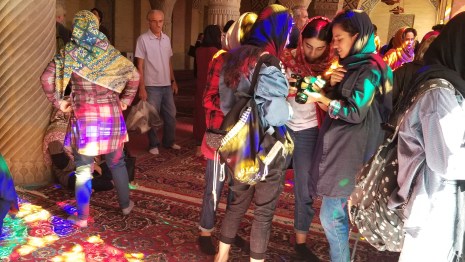
The hijab is supposed to cover all the hair and neck, but in practice, I saw many women and girls showing hair around their scarves. I was surprised how commonly women instead wore the full length chador in black.


Proper Islamic dress and attitudes toward compulsory dress codes for women is a moving target these days . If the pivot point is choice, one can understand the importance of wearing the hijab in European and American environments and the recent protests against it in Iran. For an academic paper on the history of the hijab in Iran follow this link: https://www.academia.edu/36561354/The_History_and_Evolution_of_the_Hijab_in_Iran
 As in other Islamic countries, women need not be covered in their homes. In the bazaar one can see lots of slinky long party dresses for sale and lingerie.
 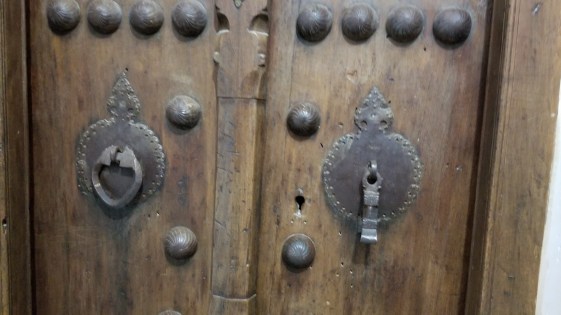 In order to protect women in their homes from “the male gaze”, there is a long history of separate door knockers for men and women. Look at the picture here and guess which knocker is for men and which is for women.
Despite the modest dress restrictions, women are out and about, with or without men in tow. They are energetic, engaged, and greeted us warmly as tourists and westerners. Most had their phones out to take selfies and pictures of the family, like everybody else in the world.
Since the Islamic revolution in 1979, women have increased their literacy rates, entered universities, and pursued professional careers. Ironically, the return to modest dress after the Pahlavi Shah’s speedy exit has made it easier for women to move about in a coed world, as their fathers feel they will be safe from harm and corruption.
As a newbie to the dress requirements, I found it very frustrating and irritating, because the extra clothing was hot (even in the fall) and my scarf kept sliding around. Since I am not Muslim (or any religion), I could only rely on my “when in Rome” values to stay on the sunny side.
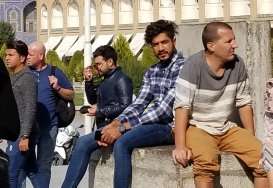
More than once I wondered aloud what ally-ship should mean for the men in our group, whose only restrictions were wearing pants above the ankle. After the revolution, women have been celebrated for their role in fighting against the Shah and western colonization. An important role was their ability to inspire their men by their piety, as evidenced by clothing choices. As I said, the meanings attached to modest dress are a moving target.
Another modesty restriction for Western tourists to expect in Iran relates to the TSA process in Iranian airports. There are separate lines for men and women, in order to pat down female passengers. Bags and other items are placed on the coed lines, as usual, but then women are diverted to a curtained area.
The only restriction that really pissed me off was one I discovered in the breach. One of the women in my touring group loved to sing and was a good singer. I also like to sing. Our group stopped in the evening at a famous old pedestrian bridge in Esfahan. We were told that people like to come there to sing because the acoustics below the brick arches are very good. Marsha and I practiced a bit of “You are my Sunshine” as we walked to the bridge. We thought we were pretty good and we got a few glances from Iranians as we passed. Only later were we told that women are not allowed to sing in public alone without men! For more recent history on this follow this link. According to the Mullahs in leadership, women singing in front of an audience that includes men is haram because it diverts the focus on religiosity to joy and entertainment. This is an old theme in monotheistic religions, mostly not enforced in non-Theocratic states. There are interest groups who are serious about enforcing this rule and there are people who are chafing under it. As in other monotheistic religions, there is theology and God, and there is misogyny, or misuse of the religious impulse for power and control. Figuring out which is which can be difficult.
We found several individuals (male) and groups (coed) singing under the arches. Here is a Youtube video of one: www.youtube.com/watch?v=gQjjS3ebz6M The group I watched in Esfahan was a mix of women and men, led by a man who was a very good singer.
Stay tuned for the next post, which will be about Persian culture heroes of the past.
 Other states, other lives, other souls