The past few weeks I have been reading historian John M. Barry’s book about the worldwide influenza pandemic of 1918, where an estimated 50-100 million people died over a two year period. This story of massive public health failure is told from the American context. That context was the entry of the U.S. into the “Great War” in April 1917 under President Woodrow Wilson. Wilson’s approach to war, once he committed, was to establish, virtually, a temporary fascist state in order to control all resources, suppress criticism, force conscription, and intimidate or punish any individuals and groups who someone might accuse of endangering the war effort. I had never learned this history of Wilson and WWI in school, and it was chilling.
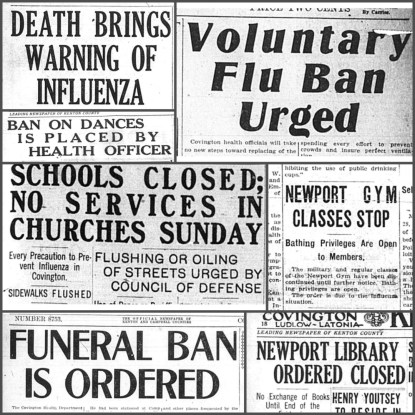
This deliberate installation of war-fascism also provided the perfect conditions for an epidemic of mild influenza to turn into a worldwide lethal pandemic. The epidemic likely began in an overcrowded military encampment for conscriptees in Kansas. As troops were moved from camp to camp, the highly infectious disease moved from camp to camp, from country to country, and finally from soldiers to civilians. During this process the virus gathered lethality with each successful passage from human to human until it was unstoppable. Dedicated medical lab scientists—a new breed in the relatively primitive state of medicine at the time—worked around the clock to determine what was causing the infections, create anti-toxins or vaccines, and convince military and political leaders to take even minimal measures to slow down the spread. As the war trumped any other policy considerations, news of the danger and actions recommended to decrease the speed of spread were deemed harmful to the war effort and were suppressed or ignored.
What I especially like about his approach is that he studied the ecology of infectious disease, immersed himself in the details of the culture of the agent, the culture of the hosts, the known ameliorations at the time and the barriers to using them.
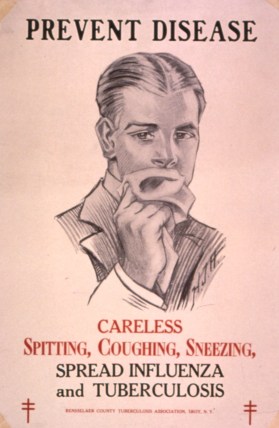 That story has reminded me of a smaller public health immersion I had when I was Director for a Health Care for the Homeless Project in St. Paul, MN, in the first half of the 1990s. During that period there was an uptick in cases of tuberculosis in the homeless population and some fear that cases of drug-resistant TB were being seen and might spread. At the time I had not yet studied the theory and practice of public health. My degrees were in psychology and early childhood education. Only later, in 2002, would I enter a master’s program in public health, encouraged in part by my experience in coming to understand the cultural context of TB.
Our public health nurse staff and I started the first step of an intervention. We put up signs around the shelters and drop-in centers advertising free TB testing dates and times. Luckily, it is a simple scratch test (Mantoux). No invasive needles or urine samples required. We made the notices in English and Spanish. Our best Spanish speaker corrected the original signs, saying that the polite version of the message would take mas palabras! On the appointed days we had a good turnout at the clinic. Our clinic staff took the test as well. Most nurses tested positive for latent TB. That is also common in hospital nurses and those who have worked in developing countries where the BCG vaccine is routinely given. No need to treat, usually, unless the case was active TB–at least the recommendation at the time.
In the meantime I started to read about active TB treatment and the causes of drug resistance. The ecology of both was fascinating and troubling. The standard treatment for active TB was a recipe for failure for many people, especially those with other problems—alcoholism, chronic mental illness, homelessness, extreme poverty, HIV and drug dependency. The drug cocktail must be taken for a long time, long after the symptoms of TB have gone away; they could cause serious or irritating side effects; and they had complicated dosing regimens. The result was that many patients stopped taking the medicines or took them incorrectly, which could result in one or multiple drug resistance. Direct Observational Therapy Short-course (DOTS) was the recommended treatment tactic to maintain adherence to the medication regimen. I encountered in the literature tailored tactics that were designed to motivate adherence, based on personal motivators. I remember one story about a public health nurse in a rural area of the south whose DOTS visits included bringing crickets as a reward for the patient who like to fish and used crickets for bait.
For our population, it seemed that homelessness was the major barrier to treatment adherence. How could a nurse use the DOTS tactics if she could not find the patient from week to week? One approach was force. A noncompliant patient with a dangerous, infectious disease could be legally held in quarantine, like a hospital bed. Was this the best tactic? An expensive one, to be sure. And one likely to enrage a patient, especially one with a drug habit, mental illness or just a contrary personality, since the treatment took months.
I decided to put together a team of people representing elements of the environment of homeless adults in St. Paul, to look at better ideas for treatment tactics. I invited the following representatives to the committee:
- the chief doctor in the city’s public health TB clinic
- a staff from Dorothy Day–the Catholic drop-in center for non-family homeless adults
- a PHN working with the population through Health Care for the Homeless
- the Director of the Union Gospel Mission–an evangelical-run shelter providing single rooms for a small nightly fee and church service attendance.
The doctor would diagnose patients with active TB; the PHN would refer to the clinic and possibly see the patient if he showed up at Dorothy Day; the local county hospital would agree to hospitalize the patient at first, if necessary; and, finally, the Gospel Mission would agree to provide a single room at no cost after a sputum test determined that the patient was no longer actively contagious, as long as the patient was successful with DOTS.
In comparison to the story of pandemic influenza, where the mandates of war made ecological decision-making unlikely, I learned that people working together, with intimate but partial knowledge of a situation, could devise tactics that addressed all aspects of the environment in which a public health emergency flourishes.
Why is this story in a travel blog? I believe it meets the mission to include cultural immersion. Was this a story about “Other States, Other Lives, Other Souls”? I think so.
 Other states, other lives, other souls