When my son began living in Medellin, Colombia, back in 2009, one of his first volunteer projects was to pay a visit to a coffee growing commune in San Jose de Alban. In college he had done a summer internship with Peace Coffee, an organic, fair trade coffee company in Minneapolis. Now finished with school and sporting a BA in marketing, he asked Peace Coffee if there was anything he could do in Colombia related to finding new coffee producers. They asked him to visit this group to find out how they were doing in getting organic and fair trade certified. The certification process is expensive and generating excess cash for the process daunting for small farmers. He suggested, as a money-making tactic, advertising the commune as a “woofer” site: Cafe Alban. There are lots of young travelers in Latin America looking for agricultural experiences. The chance to spend a week learning about and assisting in coffee production might bring in extra cash. Louis created a website to advertise the place as a woofer option and found an American willing to live there for six months as a language broker and host.
This was my first introduction to the coffee business in Colombia. From a consumer standpoint, my impression was that Colombians themselves weren’t that interested in drinking coffee, and were content to drink instant and go to Juan Valdez coffee shops in malls and drink mediocre coffee.
This month, in 2019,while sharing quarters with my daughter in law’s family, the breakfast beverage was agua de panela, rather than coffee, or chocolaté for the preschooler. Aguapanela is sugar cane water and is an acquired taste. I found it can be mixed with coffee for an acceptable morning beverage. The mother of my daughter-in-law and I got a thing going in our limited capacity to communicate: a couple of times a day I might or she might say “Quieres café?” The answer was always “si”. She had hers black with sugar; mine con leche, sin azucar.
On this fourth visit to the country, our daughter-in-law arranged for us to take the bus to the pueblo of Jardin, in the west of Medellin in the Andes, and spend a couple of days in personal tours. The first day was to motor up into the mountains to locate birds. Colombia is one of the top bird-watching countries. Jardin is a well-known spot for finding birds. The second day would be spent visiting a local coffee farm. Our guide Guillermo was well-suited for both tours. His brother was an ornithologist and Guillermo had spent considerable time developing his ability to identify birds and name them in Spanish, English and Latin. In addition, he himself was an artisanal coffee grower, as are many people in and around Jardin.
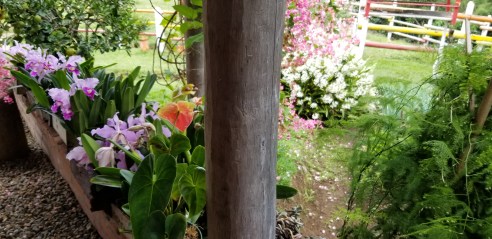 “Mountain grown” isn’t the half of it! In late morning we stopped in at a farm whose family has been growing coffee for over 150 years. The riot of flowers that greeted us signaled the incredible fertility of the region. Their land is very steep so crops are grown on an incline. Having studied the principles of permaculture a bit, I was very interested to see how they intermixed coffee plants with many other crops: bananas, corn, potatoes, onions, herbs, avocado, squash, fruit trees, and yucca.
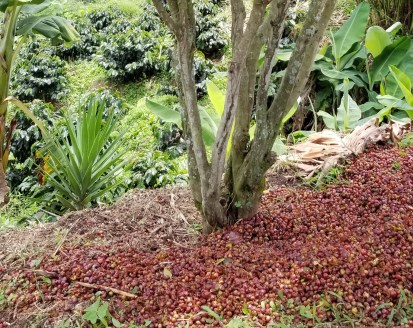
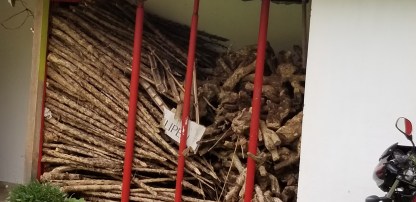 This intermixing allows them to use the cut banana leaves as mulch, the coffee skins as fertilizer for the bananas, and the other vegetable crops as distractions for the bugs and food for meals. The spent coffee plants are used as firewood for the wood cooking stove. The constantly enriched soil also means that no chemical pesticides or fertilizers are used. There is no need for irrigation because there is plenty of rain.
Of course we started the tour by suiting up with attached buckets, so we could pick our own beans. It was hard to imagine how mountain grown beans could be harvested by hand, in such a steep environment. Itinerant pickers come to the farm and are paid per 50 kilo bag. I could barely stay standing with the slope so steep.
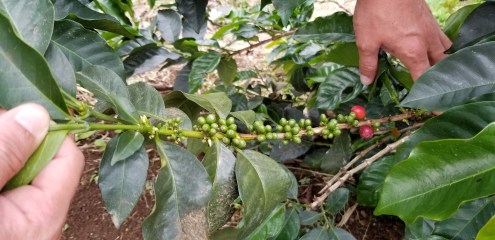 The average coffee bean branch has flowers, small green, large green and red beans, all at the same time. That means the picker has to pick the most ripe from every branch. The difference in quality has to do with the altitude and the degree of ripeness in the berry.


Once we had enough picked to demonstrate the next steps in production, the farmer took us to where the beans are weighed and dried. Three levels of quality are show on the right. A is the artisan level they sell directly; B goes to the general coffee warehouse (Juan Valdez) and C goes somewhere else (instant?).
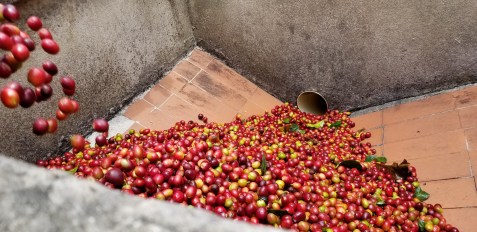 Prior to drying the shelled and husked bean, they are washed and run through a simple machine that strips the skin for mulch, discards the bad ones into a bucket at the bottom and shoots the raw beans out with water into a third area. Very loud.
After we saw the whole process we were invited back for lunch. A delicious home-cooked meal, featuring rainbow trout. And after lunch, very local French press coffee. Here on the table were the steps to making artisanal coffee. 
 Other states, other lives, other souls