Two summers ago in 2017 I got frustrated. I was trying to edge my townhome community toward a more conscious ecological perspective on maintenance decisions, but I didn’t know enough to be really persuasive. I saw an ad via email for something called a Master Water Steward program, run jointly by the Freshwater Society , and the local watershed districts around the west Metro. Freshwater Society has been around since 1968, developed in response to a catastrophic weather event that severely polluted Lake Minnetonka. I had previously taken a couple of daylong classes through Metro Blooms on raingardens and organic lawn care, so I applied, thinking it would be a short course. I forgot about it and then got an email that I was accepted. It turned out to be a deep dive into clean water activism and best management practices for keeping our common water resources healthy. It required eight months of online training and in-person classes every two weeks, culminating in a Capstone Project during this past summer. It was worth every hour.
Admittedly, I have never been much of an environmental activist. Sure, I recycle, try not to use disposable tableware, and appreciate the work of the Environmental Working Group on helping us consumers minimize chemical pesticides and herbicides in our food purchases. But I don’t drive a Prius, have a bee garden, or avoid cow meat. Maybe the responsibility of being a board member of a 41 unit townhouse with lots of run-off and a wasteful irrigation system got to me. It was like being Chairman of the Armed Services Committee when the President starts another unauthorized war. If not me, then who? Especially when the local news sources were publishing articles about the deterioration of many of our local lakes and rivers through road salt and excess nitrogen fertilizer running, untreated and unabated, into Minneapolis storm water drains.
I had never been to a Watershed District office before. To my surprise, I found three little jewels out in the western suburbs: Nine Mile Creek, Minnehaha Creek and Riley Purgatory Bluff Creek. Driving into backroads on a snowy night to class, using my GPS, I would spy a small lit building. Each had some storm water or filtration best management practice demo:
a permeable overflow parking area, a beautiful stone cistern surround, a swale, and raingarden system, artfully done. Nine Mile Creek started with a donated mid-century home that had been modified into an office and training center. It is quite beautiful.
What is a watershed? you might ask. On our first class night, the leaders provided a demonstration. On the floor they set up a large plastic tarp. Under it they made hills and valleys, with various objects. Then they took cups of water and slowly poured them down from the highest points. Wherever the water naturally went down to the lowest point, that was the watershed for that body of water at the lowest point.
Toiling in these small watershed management centers are young people with a mission. From the Minnehaha Creek Watershed office, my “home” watershed, we toured some water quality improvement projects on the Creek which starts at Lake Minnetonka and runs to the Mississippi. I learned a new word –“remeandering”. Take a creek that over time and with too much water coursing through it has straightened out, allowing silt and water to move even faster, eroding the banks and taking the silt and related junk into the Mississippi and down river. It continues down ultimately to the outer islands of Louisiana, which are losing a football field of land every hour to a toxic mix of conditions, including our contributions up north. The watershed office is coordinating an effort to put the meandering back into the creek, to slow it down, using a host of area partners and several creative tactics. 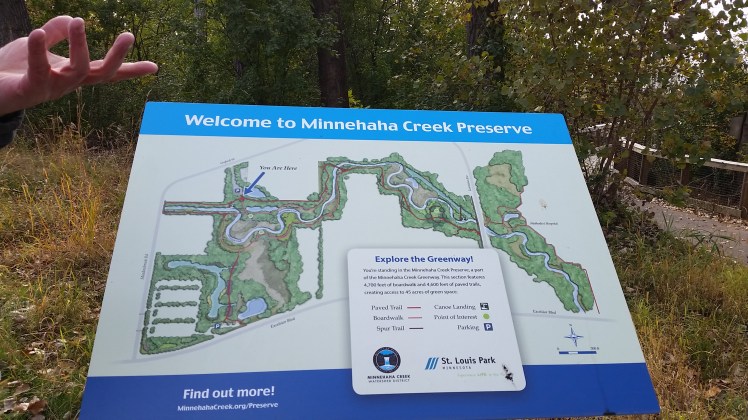 They have built a lovely bike and pedestrian trail with educational signs to bring people to and around the creek. This tactic is to build public awareness of the creek and support for efforts to strengthen it as a healthy connector between big bodies of water. This, in the context of recent 100 and 500 year rainfalls that are becoming more frequent. Tucked away out of the culture wars and partisan politics are good people thinking creatively and tactically about how to implement change through community partnerships and community education, using bridge-builders like Master Water Stewards to get more of the public on board. Imagine what we could get done if this public-spirited problem-solving could percolate back into other community and government tasks: housing for all, healthcare for all, clean air for all, good education for all.
Then in March of this year my husband and I immersed ourselves in the Mississippi River, during a month-long road trip from the Twin Cities to south of New Orleans. That trip has another set of travel posts here:
By May I was done with my studies. I chose for my Capstone Project two tactics to affect the quality and quantity of our townhomes’ storm water run-off. One was to minimize the use of salt and substitute poultry grit for traction on icy surfaces in the townhome complex.  The other was to reform our landscape irrigation system by converting it to a wifi-controlled, weather sensitive system and by instituting a best-practices watering schedule. This latter tactic has resulted in a watering schedule that cuts about 50% of the water we have been using and holds more of it on our sloping land by a “cycle and soak” pattern.
Now I am back in the dirty waters of midterm elections, fighting the garbage and toxins of “win at any cost” politics. No utopias here, but my water immersion this past year was a welcome tonic. When I pass by a storm water drain, I notice whether there are leaves or garbage piled up, ready to slip down into the sewers. I kick it away. Not on my watch!
 Other states, other lives, other souls