Growing up in flyover country (Midwest USA), we commonly take a dim view of big coastal cities like New York. We call Minneapolis the MinneApple, which indicates our aspiration for the greatness of the Big Apple, but also our preference for “small town” life (Small Town). Midwesterners often do not want to visit New York City because it is “dirty”, “crime-ridden”, and “unfriendly”. I have seen too many post-apocalyptic movies showing some place like New York with garbage-can fires tended by tattooed sullen young men under empty freeway bridges, eyeing the innocent young Midwestern woman lost when the trains stopped running.
How wrong this image is! My sister lives in Brooklyn, so I have visited it and other boroughs dozens of times. The images from the 80’s of blocks of empty graffiti-filled tenements in the Bronx and rampant crime are relics of the past. Today’s New York, and especially the Brooklyn I know so well, has lower crime rates than many smaller cities. (http://www.nytimes.com/2017/12/27/nyregion/new-york-city-crime-2017.html) Yes, some places have more garbage on the streets than Minneapolis (especially on garbage pick-up day, when shops put their heaps of filled garbage bags out on the curb). But unfriendly it is not. Just ask someone on the street where…insert your tourist spot or shop here… is and they will be glad to help you. For one reason, the streets are full of people (get ready for the shock) WALKING. Getting to a subway stop usually involves walking some blocks and many people do not have cars or dread leaving their parking space to drive somewhere unless it’s out of town. Also there are no large free parking lots so that you can drive the 4 blocks, park near the door and pop into the mall. Perhaps that is why I notice MUCH less obesity in New York City (https://stateofobesity.org/states/ny). There is a vibrant small business environment along the streets of Brooklyn run by Chinese, Arabs, Hispanics, hipsters, Jews, Italians, and old white men and women. Like getting lost in the interweb of things, one can easily lose a day wandering in an out of all kinds of shops. Where there are scads of people passing by, the fear of the stranger seems to fade.
With lots of people on the lighted streets and in the subways at all times of day and night the effect is greater safety. No walking down dark alleys, sidewalkless lonely stretches of highway, or deserted mall parking lots. I feel very comfortable being out and about after dark there as an elder, although I am rarely alone. I asked a friend my age, who had lived in Brooklyn for many years as a young woman, if she had ever been accosted or felt threatened. She said yes, once, when she passed by an old woman, said “good morning”, whereupon the crone lashed out defensively with her closed umbrella.
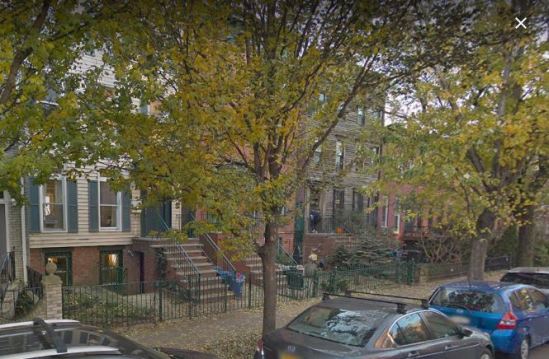 Besides the radically improved safety of this city, I am struck by how full of trees Brooklyn is (I know, I know, there is a whole book about it). In my sister’s neighborhood, a half mile or so from Prospect Park, the sidewalks are tree-lined and narrow in the residential areas. Even though the brownstones and apartments abut each other so that only tiny front gardens can be seen from the street and the backyards are hidden, the effect is still very small-town and verdant.
My sister and her family are part of a neighborhood that is friendlier than, I dare say, many a suburban one. Rather than closed monochromatic two-car suburban garage doors promising a speedy exit to somewhere else, the front doors and stoops present themselves to passersby. Rather than garage sales, there are stoop sales.
My sister’s family knows most of the people on their block, and some are close friends. They walk to pick-up soccer games in Prospect park every Sunday evening in fair weather.
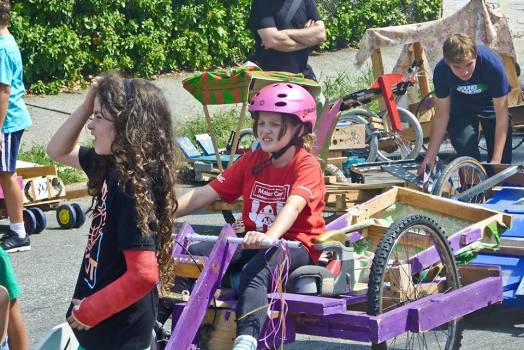
In the summer, under the auspices of a neighborhood small art gallery, they help run a day camp to build child-sized soap box race cars out of found materials. At the end of the week there is a race down 17th Street in Brooklyn. Neighbors come out to watch along with parents. You can watch a great little video showing it here: https://open-source-gallery.org/11th-annual-south-slope-derby/
In December the same gallery also hosts a “Soup Kitchen”. Here is the explanation of it from their Facebook page:
Each year the Open Source Soup Kitchen brings together artists, cooks, friends, and neighbors for a month of cooking, eating, sharing and celebrating! For as many nights of the month as we have volunteers, we will provide the cookware and utensils–and our volunteer chef of the evening will be responsible for a “one-pot meal” (usually a soup or stew) that can feed approximately 15-20 people–we welcome all kinds of unique dishes from any ethnic tradition! The cook of the night is also responsible for incorporating an artistic element into the evening–it can be a one-night exhibit, musical performance, short play, comedy routine, decoration of the gallery or any kind of artistic experience. The gallery is yours for one night–just make sure your guests are fed!
This year’s Soup Kitchen is dedicated to Tony Kalangis. For the last several years, Tony was an important and warm presence at the Soup Kitchen. He was there most every night in December, helping the Open Source staff and volunteers to clean and serve, greeting guests, telling stories and making everyone feel at home. Tony was responsible for an incredible amount of outreach to local shelters and soup kitchens, which broadened our audience and created an amazing diversity of guests every night, helping all of us to broaden our worldviews.Tony passed away this year and will be greatly missed. We are dedicating the 2017 Soup Kitchen to Tony’s memory. In his honor, we will be accepting donations for Neighbors Together.

Unlike the soup kitchens I know, this one mixes people in an arts setting. I went to one a few years ago and I had a hard time figuring out who was actually “homeless” and who was a neighbor or artist performing.
Prospect Park, while enormous, also has a neighborly air. On weekends it is full of people enjoying communal life: Dominicans BBQing chicken, Armenians BBQing goats, African-Americans BBQing pork, young Hassidic men playing badminton in dark pants, white long sleeve shirts and sidelocks, Jamaicans drumming in colorful shirts, Latin Americans playing soccer, various kids flying large kites, and mostly White fitness fanatics pedaling madly around the perimeter track at high speed shouting PASSING! or GET OUT OF THE WAY! People in their tribes without tribal warfare.
New York City gives me hope that, as the global relocation into large cities by the world’s populations continues, and people meet people from other tribes and see that they each have something to offer to the planet, we can have our small town life without the small town narrow views that often lead to disharmony or worse. By the way, John Cougar Mellencamp now lives in New York City: http://www.architecturaldigest.com/story/john-mellencamp-just-bought-a-dollar23-million-live-work-space-in-new-york-citys-soho-neighborhood.
 Other states, other lives, other souls
Hey Carol, Thanks for the Open Source Gallery “shout out!” We are having the 11th annual South Slope Derby on Saturday, August 25th, and I am flying back to “emcee.” We get started around 12 noon. –Lily
LikeLike
Wish I could be there
LikeLike