Prologue: I am an avowed Francophile. All told, I have spent about nine months in various regions: in 1965, 1993, 2005, 2006, and 2015. French is the only second language I can speak conversationally. We have hosted four French foreign exchange students and my daughter spent five weeks living with a family in Aix en Provence. I know much of France’s colonial history in Africa and have read a number of books about French monarchial history. I am currently reading a Russell Shorto book about the Revolutionary War and American struggle for independence (Revolution Song:a Story of American Freedom). I know how the French helped the colonists win. I know why Québécois speak French and how the Cajun culture was born of the ethnic cleansing of Acadians by the British in Canada. All that to say that France has a lot more to offer travelers than the Paris and Provence (My Year in Provence).
This post is about a piece of a much longer road trip I took in the summer of 1993 with my husband Phil and my son Louis, during which time my son turned 11. We started in Paris and first drove down south to drop off my daughter in Aix who at age 17 was doing a homestay. We then drove back up to Paris and took off northwest toward the Brittany coast. Overall we drove a wide circle around the west and south of France, stopping after three weeks to celebrate Louis’ 11th birthday with the Rieux homestay family and our daughter in Aix, and then returning to Paris and home. We spent a week of the trip following the history of the Cathars in 12th and 13th century France in the Dordogne and Languedoc regions of southwest France.
In case the reader is unaware, France is one giant history theme park. With a history that goes back some 50 millennia, they have a lot to talk about. This post covers a blip in time that spanned about two hundred years, the 12th and 13th centuries, prior to the Hundred Years War with Great Britain. The Cathars were a new Christian sect that arose in eastern Europe, in reaction to one of many periods of corruption in the Papal clergy and the less-than-spiritual power struggles between the French nobility and the Popes for control of the populace. Cathar comes from the Greek word for “Pure”. If you read the fascinating Wikipedia entry about Cathar theology and the Albigensian Crusade against them in the first quarter of the 1200s, you can imagine what it was like to live in the time period and what side you might have taken. In his 1944 book Axis Rule in Occupied Europe Rapheal Lempkin coined the term genocide which was used during the Nuremberg Trials. He claimed that the Albigensian Crusade was the first documented ideological genocide. The alternate term for the Cathars—Albigensians–got its name from the town of Albi, which we stopped at on our way. More on Albi later.
 This route was fantastic for a preteen boy, who was not allowed to have present day toy weapons, but could run around medieval French castles, night and day, with a wooden sword. Our route started in the Dordogne, AKA the mountainous region of Perigord, entering from southern Brittany. To arrive in Cathar country we drove through Niort to Cognac to Angouleme, and finally to Perigeux, the central city of the Perigord region, in the foothills of the Massif Central mountains. Perigeux was where our Cathar history tour began.
On day one we toured Medieval castles at Beynac and Castelnaud. These two sit in plain view of each other across the valley divide of the Dordogne River (see the Featured Image). Both figured in the Hundred Years War on opposing sides, but before that time Bernard de Casnac’s fortress Castelnaud supported the Cathars. During the early 13th Century the notorious Count Simon de Monfort reigned terror on behalf of Pope Innocent III, taking the Castelnaud but losing it a year later. After that it was burned on orders of the Archbishop of Bordeaux, and then rebuilt before the end of the 13th Century. The route and rout of Simon de Monfort and his Albigensian Crusaders took the opposite direction of our route, starting with a massacre in the south at Beziers and working his way up into the Perigord.
 Now Castelnaud is a museum of Medieval warfare. Louis enjoyed the suits of armor, weapons, and especially the Trebuchet catapult. We learned that this large catapult propelled not only boiling oil and rocks, but putrefying corpses and barrels of excrement, meant to infect the enemy.
Our next full stop on the Cathar trail was Albi, a World Heritage site. This is a must see city, for many reasons. From our theme point of view, this is where Pope declared victory over the Cathars. To prove his point, he erected an enormous and ominous ovoid pink brick fortress/ cathedral. On the inside of the unadorned exterior is a grand showcase of the wealth and majesty of the Holy Church.


t the front is a mural showing both the joys of Heaven and the grizzly tortures of Hell. The ceilings are covered with gilt paintings illustrating dozens of Bible stories. In various nooks and crannies are reliquaries. A handout by the Bishop of Albi at the time of our visit in 1993 cautioned that “One should view the murals of Heaven and Hell as nothing less than a realistic portrayal of what awaits our souls.”
The pink brick former nunnery in Albi is now a museum celebrating the works of Toulouse-Lautrec, a native son. The River Tarn winds through the lowest point of Albi, with multiple pinkish brick bridges. Quite a lovely sight, despite its violent history.
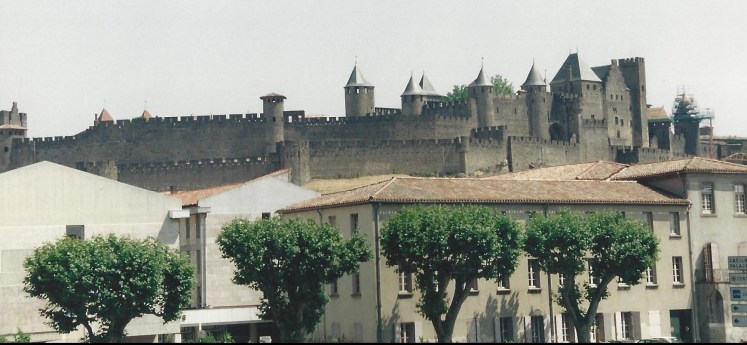 A final recommended stop is Carcassonne), also taken by the Count de Monfort. We skipped it on that trip, because we had been before and it is plenty touristy. We also did not stop in Toulouse, where Simon de Monfort met his death at the hands, legend has it, of the women and girls left after the initial massacre. Not satisfied with the defeat of the Cathar leadership and feudal supporters by the 1220s, in 1233 the new Pope Gregory IX ordered the start of an Inquisition against remaining faithful, led by the Dominican order. I see that now in 2018 there are tours of Cathar castles and history in Languedoc. It sounds wonderful. Or you can just surf the web and imagine.
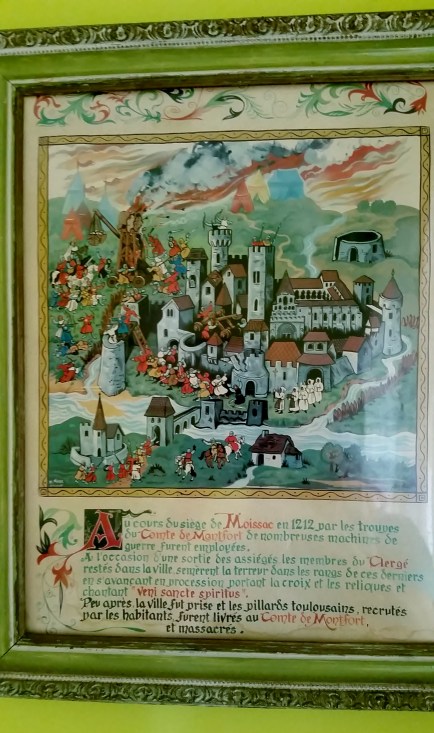 Shortly after we returned home I stopped in at one of my favorite antique shops in Minneapolis. I often pick out frames or interesting pictures. Imagine my surprise when I happened upon a framed page of illuminated manuscript with a Medieval-looking scene and French explanation. The back of it said it was from Toulouse and would cost me $12.00! It told the story of the siege of Moissac (this a a 20 minute audio story) by Monfort in 1212. Moissac is a small Medieval town north of Toulouse that is a stop on the famous Santiago de Compostela pilgrimage, popularized in the movie The Way. It is now also a World Heritage site. Depending on what website you choose, it is another example of the vicious brutality of the Albigensian Crusade leader or an exciting example of warfare and weaponry by Christian saviors. It now adorns my kitchen.
 Other states, other lives, other souls

One thought on “Road trip to Medieval France: Following the trail of the Cathars and the Albigensian Crusade”