Have you noticed that there is a second (or third or fourth) back-to-the-land movement among young people? While most young people are leaving their family’s farm and small town in droves, some urbanites are leaving big cities and establishing organic and more or less self-sufficient outposts in smaller towns and rural areas, living out their deep concern for the fate of the planet and its denizens.
My daughter is one of them. A graduate from an international social policy school in the Netherlands, Peace Corps volunteer in Madagascar and South Africa, she now lives in an urban homestead in Helena, MT. Visually, this means that her 1 and ½ lot, which used to be all Kentucky bluegrass with a few trees and a decrepit pergola, is now a mini farm, complete with rabbits, chickens, medicinal herbs, fruit trees and perennial foodstuffs. In Helena, which only gets about 12 inches per year of rainfall, this is a challenging mission. Part of the reuse/recycle ethos means that there are also a lot of spare parts, awaiting their reuse. Right now that means: organic straw bales, leftover barn wood, a load of maple gym flooring, old lodgepoles and wild willow for fencing, and rabbit manure for the garden. In Helena, which has that live-and-let-live ethos of the West, her neighbors don’t seem to mind. Like many farmers from earlier generations, she supports herself with a number of skills and gigs that are mutually reinforcing.
We just came back from a quick visit in honor of her daughter’s fifth birthday . Alder, named for one of the very beneficial trees valued by permaculture advocates, says she wants to be a farmer when she grows up. Right now that means she likes to help her mom: planting, finding eggs, helping harvest rabbits, and eating wild greens from the garden. Too early to say whether tougher chores at a later age, like mucking out the rabbit pens, will dim that enthusiasm, like it has for many traditional farm kids.
Like most farms, the work never stops. But my daughter has made up for the lack of a family full of farm hands by taking in roommates who, in order to have lower rents, agree to help with some of the chores, especially when she must be gone. This was one of those times when, after the birthday party, she headed off to San Francisco for a training in strategic social engagement organized by a British sustainability advocacy group.
Since she doesn’t have the benefit of parents/grandparents around to help with things from time to time, we frequently ask what we could do for her when we are there. Here’s what happened this time:
- Re-attached a few barn wood boards from the fencing that covers the property and keeps out the deer and foxes and keeps the chickens and rabbits in (Carol, who loves wood projects)
- Mucked out several months (years?) of rabbit manure mixed with straw from the rabbit pen and placed in the compost bins. Replaced with fresh organic straw (which Jess sells in the fall). The chickens and rabbits went wild, looking for edible items in the new straw.
- Straightened out the many hundred pounds of maple flooring which got hit over the winter by a car sliding into it from the alley. (Carol and Phil) This took some brains, because our brawn was not enough to move the wood. Re-attached the plastic that covers it all and keeps out the rain and snow.
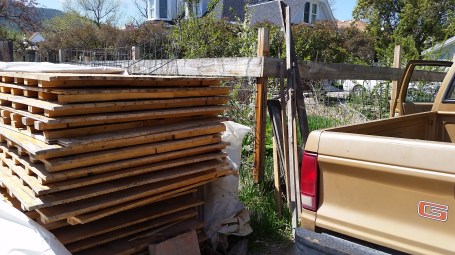 This last chore we were especially proud of. We figured out that we could use Jess’ old truck to push or pull the pile of wood back into position. With her suggestion of the straps in the back of the truck, we wrapped one around the pile and hooked it securely to the hooks in the truck. Remembering my many years of cars with manual transmissions, I inched forward in the alley and—Voila! You see the completed chore and the back of the truck, but not the before.
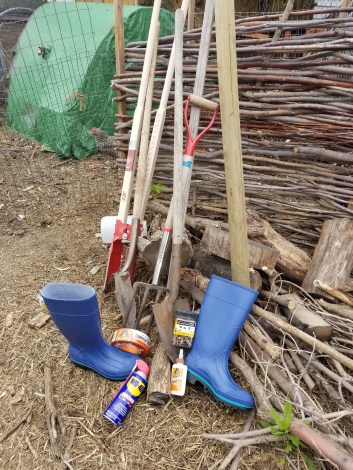 Here are the tools we amassed to carry out our assignments: Wood glue for repairing the split barn wood. Blue rubber boots for mucking out the rabbit pen. WD40 for cleaning up Phil’s rusted mountain bike chain. Duck tape for repairing the shredded plastic covering the maple gym flooring. Shovels. Brass outdoor screws for the fence repair.
Before Jess left for the coast, we observed a farm chore we hadn’t seen before: the rabbit home abattoir. At about 3 months the rabbits she is raising are at the best age for harvesting. She or Alder hold the rabbit, petting it to relax it before quickly breaking its neck with a specially designed steel V. No sound comes from the rabbit. Then downstairs to be skinned and cleaned out. 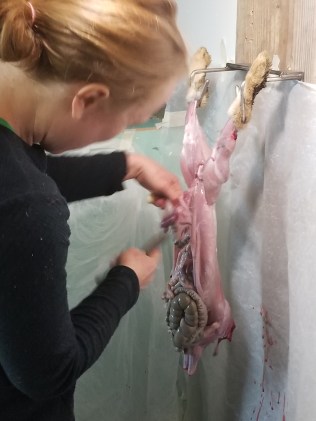 All the parts to be used are saved for human or canine. Then it is upstairs to be cleaned in cold water and quickly frozen. The unused parts are buried, to join in the soil-building process. Rabbit stew or soup is delicious.
We also learned how to clip chicken wings, to keep them from fluttering over their fence and into the yard. Again, no pain, because it is like clipping fingernails.
Then we rested.
This is actually some ceramic sculpture at the Archie Bray Ceramic Center, a world renowned residency built on the grounds of the original brick making factory in Helena.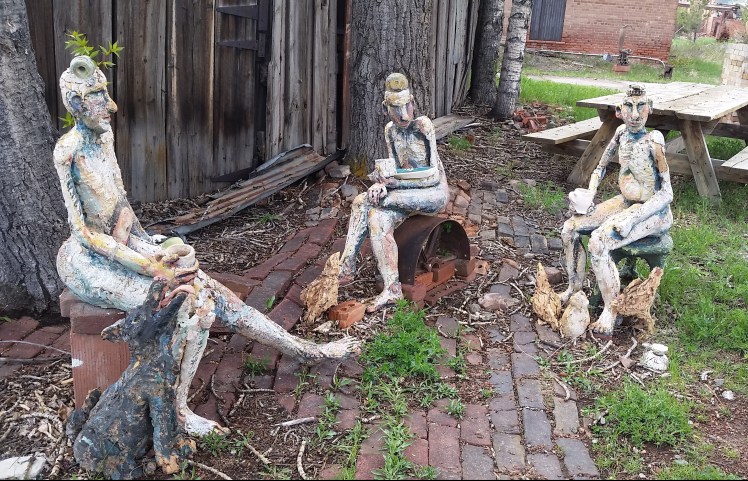
 Other states, other lives, other souls