On day 8 of our month long road trip through the American Southwest we reached our campsite at Lake Mead near Hoover Dam.  Hoover Dam was the first dam on the Colorado River built during FDR’s presidency. This water recreation area on the Arizona border is a short tourist bus ride from arid Las Vegas. Mid-March was pretty hot, but the campsite offered some large trees and shade. After setup, as we looked around the camp, we noticed that it seemed a bit down at the heels, with other tent sites that looked like they had been occupied by the same tenants long enough to look more like a homeless encampment.
I remembered from my years directing a Healthcare for the Homeless Project in St. Paul that someone had mentioned that there were a lot of homeless people around Las Vegas. I assumed it was the losing side of Sin City, where gambling addicts ended up when friends and family loans dried up. Lake Mead campground seemed to be one of those places for the rock bottom crowd. Discarded plastic bottles, cigarette butts, and piles of aluminum cans awaiting the trip to the metal recycler littered the camp. As we made our way to the bathrooms, we filled a bag with detritus to place in a nearby can.
Not soon after we had finished our official cocktail of the trip (the camper’s margarita) and started thinking about dinner, our camp neighbor to our left asked Phil over to see if he could help her start her old Coleman stove. He couldn’t figure it out, but got quite a story from her in the process.  Her set up was a large tent with a fenced-in area for three large black labs. Nearby was an old International Travelall wagon. She claimed that her partner (husband? fiancé?) had suddenly been “called away on business”, leaving her at the campsite with no way of leaving to re-provision, since she didn’t drive. She thought he would be back soon. She was down to ramen. Another camper last week had taken her in to the closest store to get groceries. They had been traveling from place to place for months. We filled in the blanks in her story with our vivid imaginations.
To our right were two small interconnected tents with a very large collection of smashed aluminum cans, covered loosely with cardboard. A woman emerged from one of the tents and paced about like she was out of it in one way or another. She seemed to be picking a fight with a man nearby. That man left for a while. A short while later a car drove up through the camp with the harassed man and several other guys, with some food. The pacing woman had been cooking a steak over a campfire grill, but seemed to have forgotten it. A short while later she came back to the steak, picked it up and threw it at the man. End of Act I. Act II: After we had gone to bed, about 10:30 pm or so, the same car and some more food showed up. More swearing. Luckily, no one seemed to have a weapon visible, so we were not frightened, only curious about what Act III might bring.
In the morning it seemed that Act III was sleeping it off, so we fixed breakfast and then drove off in search of some kayaking opportunities on the Black Canyon Water Trail section of the Colorado River. 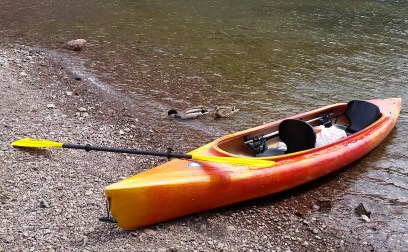 We learned that the start of the water trail at the base of the Hoover Dam required a minimum of 48 hours advanced permitting, so we settled for renting a double kayak at Willow Beach, 13 miles below the dam.
Lake Mead and this section of the Colorado River, which runs 1450 miles from the Rocky Mountains into northern Mexico, are situated in the Mojave Desert, an arid and unremarkable place transformed into a major recreation area and source of hydroelectric power by the Hoover Dam. Las Vegas, as Sin City, was created in part by the raft of workers who came to build the dam in 1931. The dam and its younger sister Glen Canyon Dam have been controversial Bureau of Land Reclamation projects since their beginnings. The roots of the Environmental Movement can be traced to the reaction to the massive terraforming for electrification hailed by some (Woody Guthrie and Roll on Colombia) and reviled by others (Edward Abbey and The Monkey Wrench Gang). Dams create winners and losers. The last 100 miles of the Colorado River has all but dried up and has not reached the ocean since the 1960s, due to overuse of water by inappropriate urban development in Arizona and diversion of upstream water to other cities and agriculture.
Our tiring 5 hour kayak trip, first upstream toward the dam and then downstream, but into a strong wind, was lovely and empty with places to beach the boat and hike on the ridges above the dramatic black water. Farther along were remnants of old mining lookouts and cable strung to take guards across the river in precarious open cages. At the end of the day, one more camper’s margarita and a Coleman supper. Good-bye to Lake Mead and its down-and-out denizens. On to the south rim of the Grand Canyon!!
 Other states, other lives, other souls
One thought on “Southwest Road Trip: Chapter 2-Busted Flat at Hoover Dam (with thanks to Janis Joplin)”