This is the script for a winter solstice celebration we have held for the last dozen years or so for friends and family. We travel back in time to share the fear, wonder and hope that our ancesters felt witnessing the hours of warming sun shrink until its nadir in the northern hemisphere Dec. 21. Feel free to use if you would like to create your own celebration.
We are gathered here in the dimming light to celebrate an age old event that connects us deeply to our history as a species and to people in many parts of the northern hemisphere. In China, the holiday is Donzhi, in Iran, it’s Yalda, for Zunis it’s Shalako, and so on. In the southern hemisphere, it’s celebrated in June. For the Mapuche Indians in southern Chile, it’s called We Tripantu.
We celebrate the winter solstice or Yule, the time that, because of the tilt of the earth, we see less of the sun than any other time of the year. We are technically nearer the sun than in June, by 3 million miles, but if it doesn’t shine on us much, it’s scary. We gather by the fire and hold each other close. An incantation by Kenneth Patchen: “To Whomever these village fires still have meaning. O may your own most secret and most beautiful Animal of light come safely to you.”
Some Solstice celebrations harken back to times when people lived in tribes: the Celts, the Norse, even Neolithic people. Without benefit of science and technology they placated their gods, hoping to live through the long dark winter. They carefully plotted the weather to keep starvation at bay. Our celebration looks to the present and the future. We are all one tribe—the human tribe—under the same sun and caring for a whole earth and its living organisms.
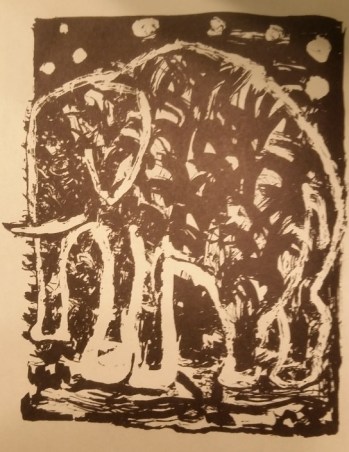
Here is a picture poem by Kenneth Patchen that sets the stage: “O “listen” is like an elephant who stalks the woods at night & with his mole-soft & curling trunk Touches all the stars with light. & written on his nobly gentle sides Are the names of trees & fields & [women and] men. Of where we shall go tomorrow and of what it will be like then.”
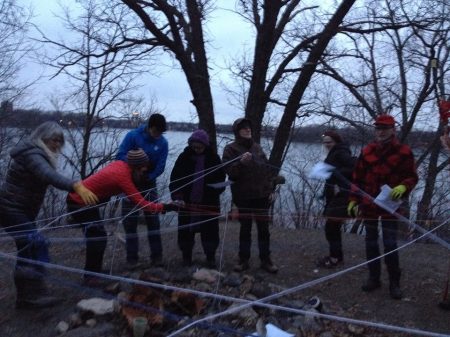
The word Solstice means sun standing still in old French. Maybe if it is standing still, we can catch it, and keep it here to cheer us and keep us warm. Let’s try. We’re going to make a web to try to catch the sun. Please pass the yarn… While we do that, here is a metaphorical spider poem by Walt Whitman.
 “A noiseless patient spider,
I’d mark’d where on a little promontory it stood isolated,
Mark’d how to explore the vacant vast surrounding,
It launche’d forth filament, filament, filament, out of itself,
Ever unreeling them, ever tirelessly speeding them.
And you O my soul where you stand,
Surrounded, detached, in measureless oceans of space,
Ceaselessly musing, venturing, throwing, seeking the spheres to connect them,
Till the bridge you will need be form’d, till the ductile anchor hold,
Till the gossamer threads you fling catch somewhere, O my soul.”
Come to us, Sōl, our souls yearn for you, Sol. We promise to be good; to care for the earth; to preserve it for the generations to come. Come, come back!
What if we really could capture the sun in our web? Come close and drop your piece of the web in our fire. I think we have to admit, that we humans, smart as we are with our Iphones, and our blue teeth and our HDTV and our GPS, that there are forces we can’t control and we better not mess with.
We know that as we engage in the struggle to cool our mother earth that fire is both our friend and our enemy. For big dualities like that, humans need magik. And to win the battle against those who would trash our mother, we will need magik as well as reason.
Now on this shortest of days we are going to invoke an ancient power, a power that separated us from animals – the power of fire. We ask some of our youngest celebrants to come forward and light our torches. Those without torches light your candles and circle on this beautiful snow (or strangely snowless frozen ground). Let the magik of friendship and hope unite us.
While we keep the fires burning, we can share some of the mysteries of the universe–that fill us with wonder and awe. Thank you to astrophysicist Neil de Grasse Tyson, for sharing some of these wonders. Let’s do this as a call and response. We’ll go around the circle. As someone reads one of them, we all say “Ah, the mystery!”
- There are 100,000 times as many stars in our universe as sounds and words ever uttered by all humans who have ever lived.
- Because light takes time to travel from one place to another, the farther out in space we look, the farther back in time we see. With our most powerful telescopes, we can observe the universe all the way back to its earliest moments — all the way back to the Big Bang itself. And now some astrophysicists say the Big Bang was not the beginning, but just an explosion building one of many universes.
- With chemical elements forged over 14 billion years in the fires of high-mass stars that exploded into space, and with these elements enriching subsequent generations of stars with carbon, oxygen, nitrogen and other basic ingredients of life itself, we are literally made of stardust.
Now if anyone else wants to contribute a wonder, say it out loud. Then, we will all respond as before. Does anyone have something else to share?
We will end this outdoor celebration with two little poems: the first, a bit of perspective from an unnamed Chippewa Indian, courtesy of Robert Bly:
“Sometimes I go about pitying myself, and all the time I am being carried on great winds across the sky.”
The last, to bring us away from the fire and back to a warm house, is a poem by the granddaughter of a Welsh/English poet and the daughter of a man named for Robert Browning.
“Behold the early falling of the light.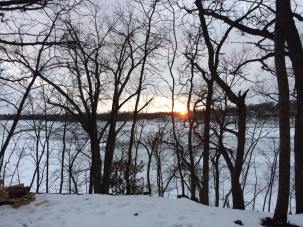
The creeping cold, the dimming of our sight.
But hark! a hoot comes from the darkened trees
A call, and then another ‘cross the freeze.
A stillness, crisp and thin, descends to earth
A star and then another given birth.
Fear not, for winter’s visit has an end.
Go forth with fire and cloak and greet this friend!
2017
 Other states, other lives, other souls