Six years ago (2011) our son was living and working in Medellin, Colombia. It seems that North Americans, when the topic of Medellin comes up in the conversation, immediately go to Narcos and Pablo Escobar. It’s like if you said you were going to visit Chicago, your friends would say: aren’t you worried about Al Capone? Old news.
In 2017 Lonely Planet named Colombia its number one country to visit. Medellin’s nickname is the City of Eternal Spring, and it’s well deserved. Take San Diego and add a rainy season and mountains.

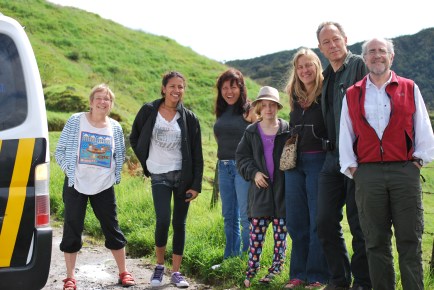
This was our second visit and this time our son had arranged a trip to the Caribbean Coast for me, my husband Phil and my sister Lily and her family. It was led by his musician friend Dorcas, who was born on the coast in a small Afro-Caribe village, and her mother, an Indio evangelical minister. We borrowed a van and eight of us took off at dawn over the mountains toward the coast.
A year earlier on our first visit we had flown from Medellin to Cartagena, a well-known stop for cruise ships on the Caribbean and the romantic city in the movie with Michael Douglas and Kathleen Turner, Romancing the Stone. A 500 year old walled city whose claim to fame is that it never surrendered to pirates when all other cities on the Caribbean coast of South American did in the 1500s. Honestly, we were underwhelmed after one day. Pretty, ancient, and a bit too World Heritage, preserved in a bottle for us.
This time we were hoping for a more cultural experience, sampling three of the major ethnic subcultures of Colombia: Afro-Colombian, Indigenous and Spanish/European . Dorcas is a singer and guitar player who competed in the Colombian version of American Idol and went to college in Medellin on a scholarship awarded to her as a representative of an ethnic minority. We would be visiting her father, an artisan fisherman and mayor of the very small village, as well as hitting other spots of interest along the way. As she is one of the more beautiful young women on the planet, I found in reviewing our photos after the trip that there were an outsize number of Dorcas in bikini in surf, on rocks, on driftwood—you get the picture. Those were not the ones I took!


Step one was a weekend stay at a finca near the coast in Barranquilla, north of Cartagena. This is a classic Spanish Colombian way to take a family vacation away from the city. Fincas are small enclosed living quarters and grounds, big enough for one or two families. There is dormitory-style sleeping and a well-provisioned kitchen with outside grills for barbequing Colombian style. There is always a pool in the middle. Music was blaring after dark; there was salsa dancing around the pool, featuring lessons taught by my son and Dorcas. Dorcas’ mom made comfort food for us all.
Next we went to the town of San Bernardo, south of Cartagena, near the village where Dorcas had grown up. We stayed in a newly reopened hotel, which had seen better days. Perhaps the marks on the walls were bullet holes. Our son said that this was the last town to end the drug running in Colombia. Last, because the local drug lord had been captured by the Americans, leaving a leadership vacuum which resulted in renewed bloodshed as warring gangs sought to control the trade. For our post-bloodshed visit Dorcas had thoughtfully organized some high school musician friends to come to the hotel courtyard after dark and perform for us. Dorcas sang and played guitar and her friends picked up the tempo and two dancers whirled around. We were especially impressed by the young man playing the leaf.


My sister, the professional sax player, had brought her sax, hoping to sit in. They were delighted, but instead of having her sit in, invited her to play solo while they took a smoke break. That was good too.
The next day we went to meet Dorcas’ father in the small village. We had met him earlier in San Bernardo selling fish out of his cart. The village featured dirt streets and handmade picket fences surrounding small hand build houses and tidy yards, with chickens and small goats everywhere.


Her father was an ebullient handsome man, obviously very fond of his daughter and cordial with his ex-wife, her mother. First he took us to the village jumping-off spot for fishing in the mangrove swamp. We climbed into two long canoes carved from tree trunks and followed his lead through the mangroves out to the edge of the ocean, using hand carved wooden paddles. We pulled the canoes onto the sandy beach where we 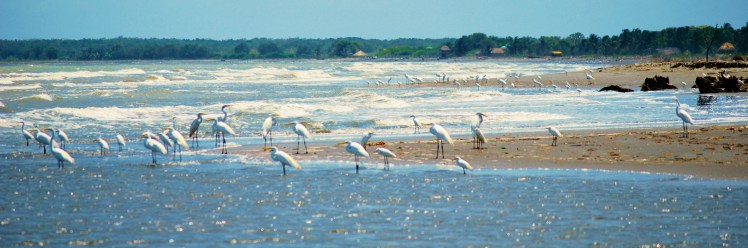 swam and watched the myriad wading birds and drank coconut water out of freshly cracked coconuts. Following our paddle we went to Dorcas’ childhood home for a fresh caught crab lunch. Her home was a basic three room wooden house and a balcony on stilts, with no running water, plumbing or electricity. The kitchen was a separate roofed shed, open to the elements, which are pretty nice elements, provided there is no hurricane. The lunch was delicious.
The final day we drove back over the mountain main road, sprinkled every few miles with soldiers with AK47s, a reminder that things were not always so peaceful. Back to Medellin, a vibrant metropolis on its way to becoming a progressive engine of commerce, industry, agriculture and public art. Under Sergio Fajardo and a series of progressive and innovative mayors new beautiful libraries were built on the hillsides where the poorest citizens live and a Metro cable and giant escalator made it possible for barrio residents to ride down to jobs in the city center at the bottom. Go visit! Dust off your Spanish and you will have even more fun.
 Other states, other lives, other souls
One thought on “It’s Colombia, not Columbia!”