In a previous post encouraging folks to plan their own travel (I can do it by myself!), I listed nine goals for travel I apply in the planning process. Two are the subject of this post.
- You are more likely to meet the locals or other diverse travelers that enrich your experience of the place
- The ability to have more unusual experiences that a group and a travel company can’t manage.
I promised to share some of the stories from our Peru trip in 1999 that were “Crazy, Lucky, Funny, Poignant, and/or Scary.” Here they are.
Crazy, Funny
When you’re not riding on a tour bus it’s easy to meet other travelers, especially when your husband is an 11 on the 10 point extraversion scale. We first met Laura and Jonathan at the expat Cross Keys bar in Cuzco. They were on their third week in Peru and, since they had no formal plans, joined us in touring of the sites around Cuzco in the Sacred Valley. Jonathan was a disillusioned telejournalist in Boston taking a break on his way to law school; single, low 30s, a bit dissolute and leftwing in an exciting sort of way. Laura was a wealthy Dallas housewife, recently divorced, somewhat older, apolitical, and looking for excitement.
We had one of those “bare your soul because I will never see you again” extended conversations the next night over too many Pisco sours at an empty hotel bar near Pisac. After covering religion and stepchildren, we got on the subject of psychedelics. Jonathan reportedly had extensive experience with them and other drugs; Laura, none. Unbeknownst to Laura, Jonathan had decided to take on the role of mind-blower mentor. He had arranged a trip to visit a local shaman somewhere in Amazonia to give them the experience of trying ayahuasca. A noted purgative and hallucinogen, ayahuasca had left the confines of the indigenous people of South America and found its way into subcultures of those westerners wanting spiritual, magical experiences. He told Laura that he wanted to visit Iquitos to go into the jungle, but not about the drug plans. When they got to Iquitos he revealed his plan to Laura, after getting a shamanic contact from a local cab driver. Laura flipped but after a night of intensive discussion agreed. They traveled a full day into the jungle to find the shaman who prepared the brew and administered it. Laura proceeded to shit and puke just outside the shaman’s stilt house in the jungle for a while but then had wonderful visions of flying horses and the unity of all, etc., etc. Jonathan, on the other hand, had auditory nightmares of chainsaws buzzing, destroying the rainforest, along with complex thoughts about distribution networks.
Funny, lucky, poignant
Our second afternoon in Cusco we left the lunch restaurant in the center of town and wandered into the Plaza des Armas. While sitting on a bench we spotted two young people sitting close to each other on a similar bench across the plaza. 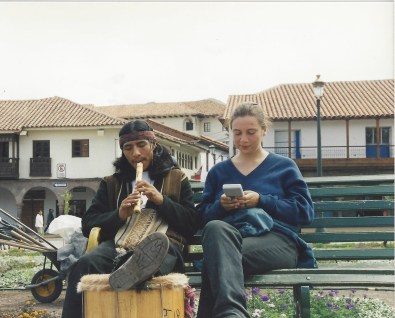 One was playing a typical Andean bamboo flute and looked Indigeno and the girl was playing with a Game Boy and looked European. We thought it would be a cute photo so my husband Phil walked over to ask if we could take their picture. The girl, who was Israeli, said to Phil: “You like sexy woman?” Phil said: “Yeah, but that’s my wife over there.” It turned out that she was actually asking if we wanted to visit the Incan fortress above Cuzco called Sacsayhuaman. The boy, a local Quechua, offered to take us up there and to other sacred sites by horseback. That sounded like great fun. We told them that we would be leaving in the morning for five days touring the Sacred Valley and Machu Picchu, before returning to Cuzco. They said, no problem, they would come to our hotel when we returned.
When we returned to the lovely Hotel Loretto there was a message from Amaru. They would be happy to take us the afternoon of the next day. At 2 pm they appeared and we took a cab up the mountain to Sacsayhuaman. Amaru negotiated a good price for the horses. Fadi, the Israeli, would be the translator. The nags had primitive equipment for riding, but we were in no danger of getting thrown from a galloping horse. Amaru took us to the Temple of the Moon, a cave near Sacsayhuaman, where Amaru claimed the Quechua hippies gathered under the full moon to smoke dope, listen to the old ones and bare souls. Holes in the ceiling of the cave allowed the moonlight to shine through. Pre-Incan, he said—the old time religion.
After two hours, we dismounted and walked back down into Cuzco as the sun was setting. Sublime! We invited Amaru and Fadi for drinks and dinner in Cuzco. As we chatted, we found out that each of them had been in their respective militaries. Amaru showed us his bullet wound, a result of skirmishes with Bolivia. Fadi’s view of the military was colored by her commanding officer– a kind of social worker or father figure. Amaru’s experience was of sadistic disciplinarians, frequently using violence, even death, to instill the proper behavior in the young soldiers. Fadi was desperate to bring her Quechua lover back to Israel in hopes of a better life for him. She had a scheme to peddle Peruvian hides to raise enough money to bring him over.
After dinner we ended the evening at a nightclub. An Indigenous band called Totem, wearing black leather jackets, played flutes and guitars in a fusion of Andean and rock music. Everyone was on the dance floor freestyling . We thanked Amaru and Fadi for a lovely day and hoped that their dreams would come true.
Lucky, Scary
There were several scary things that happened on the trip. The first involved our drivers Efraim and Franklin, commissioned by Tambo Tours to take us in a small van from Cuzco to the train to Machu Picchu at Ollantaytambo. The plan that day was for them to take us up the mountain along the raging Urubamba River to see two typical Quechua villages—Huilloc and Patacancha. Up and up we went on a single lane wet mud road with no shoulders, as it was early April, the tail end of the rainy season. 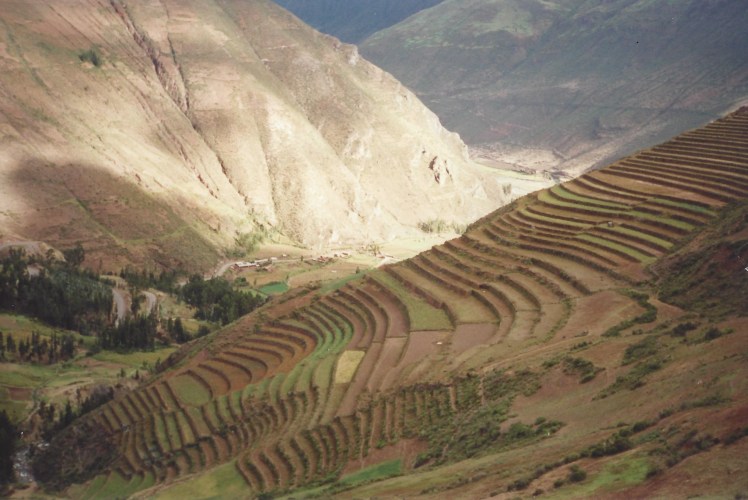 The views were spectacular, with ancient terraces climbing the mountain with us, goats, sheep, pack mules, and people, either working in the fields or following sheep. The people were all dressed in the typical bright reds, boiled wool sun hats, and woven wool capes against the chill of the high altitude ~10,000-12,000 feet).
 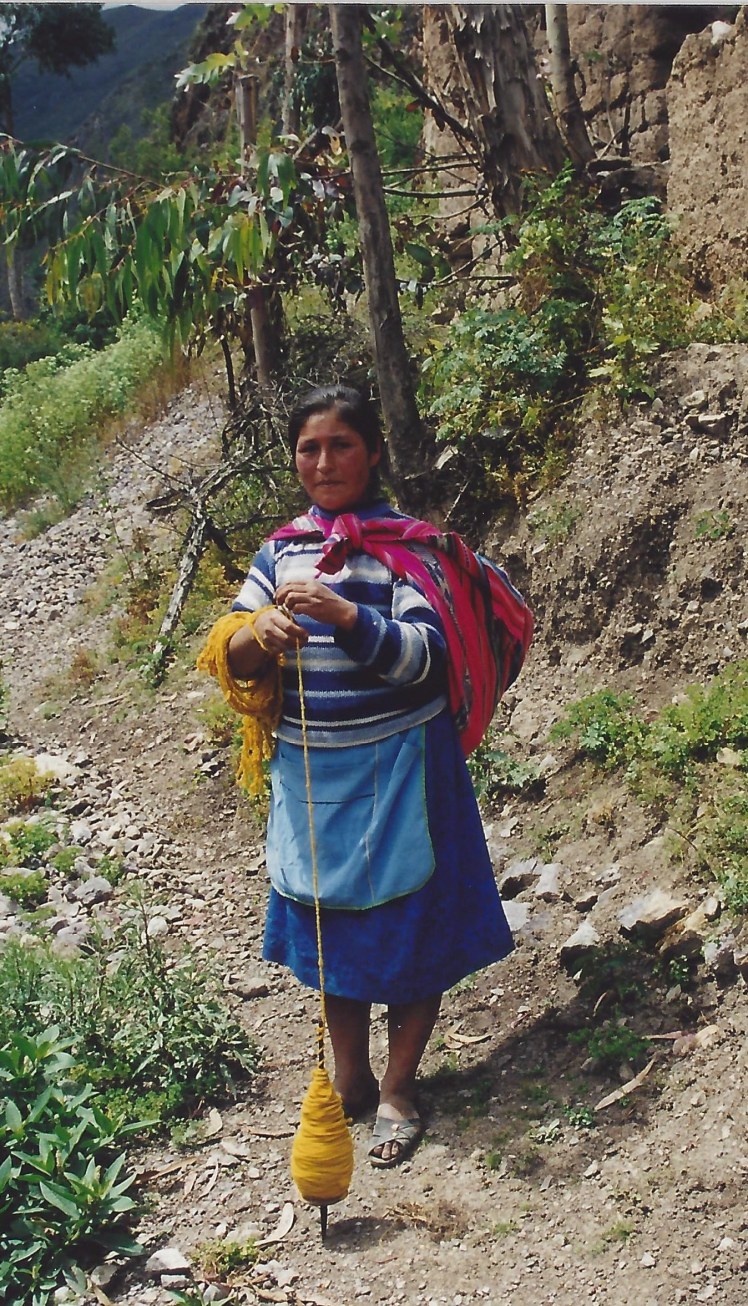 On the way we picked up a hitchhiker, a Quechua woman carrying her hand wool spinner, so as not to waste any time that could be put to labor. Patacancha Weaving Community
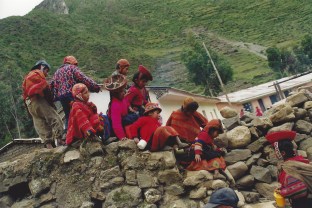 At Huilloc it was just our luck that the school children had just then come outside for recess as we arrived. Flock of children like little red birds flitted about the grassy playground, climbed the stone walls
 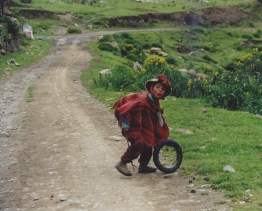 enclosing the playground, and ran along the road rolling hoops with sticks. Our next stop was up the mountain at Patacancha Village. The road got wetter and deeper in clay. We began to slide closer to the edge. Panic! The drop-off was at least 1000 feet. Franklin was willing to keep going, but, sensing oblivion, we asked him to STOP, so we could get out of the van and walk the rest of the way.
 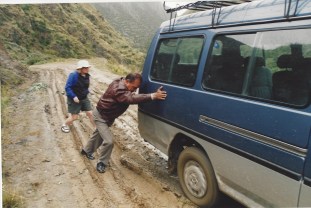 Advice: If you are uncomfortable in a vehicle, demand changes. People get injured or die in car crashes all the time. Don’t be one.
At Patacancha we were able to observe briefly a first grade classroom. About ten children were hard at work on tangrams (set problems). Posters of Peruvian/Indigenous heroes decorated the walls—Simon Bolivar and Tupac Amaru. Doors were open, letting in the cloudy light, as there was no electricity. The children wore the same woolen shawls and hats as outside, as there was no heat. We found out then that the school and area was a target of Mormon missionary work, part of the “building of Zion”, a project which continues to this day and is fascinating/scarifying in its own right. (Building Zion)
On the way back down the mountain we picked up two teachers heading back down to Ollantaytambo at the end of the school day. They said that it took them two hours to walk down! We were grateful that we had been given an opportunity to visit two of 900 self-sufficient indigenous communities in one of the most beautiful and fertile places in the world. In 2017 I see that there is a bike tourism industry taking adventure bikers up to Patacancha and letting them whiz down the mountain. Sigh!
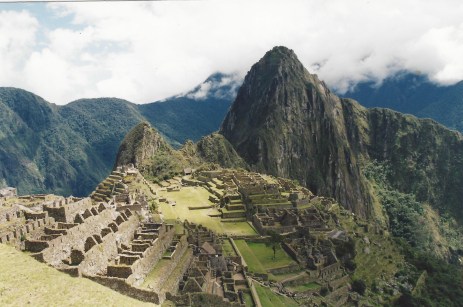 Our final scary event of this trip was climbing up the Huayna Picchu peak above Machu Picchu, as seen in the classic photos. It was considered one of the more dangerous climbs in the world because of the altitude (1000 feet straight up from 8,500), ancient narrow stone stairs without railings, and slippery footing during the rainy season. Huayna Picchu Apparently the myths of many deaths during the climb have been exaggerated, but in 1999, there was much less information and no preregistration before climbing. In my 50’s and coming from Flatland USA, I had to stop every hundred feet or so to stop my heart from pounding. Not a problem because the views from any point were amazing.
  The danger seemed well worth it as the 360 dizzying view at the top was worth a permanent photo on our bedroom wall. The trip down was easier on the lungs but more dangerous because of the slippery footing and chance to go too fast. Evidently we made it, as I am not writing this from the grave.
 Other states, other lives, other souls
One thought on “Crazy, Lucky, Funny, Poignant, Scary: Peru, Part 2”