
Irony: a state of affairs or an event that seems deliberately contrary to what one expects and is often amusing as a result. (Google)
I spent one month in Sierra Leone, West Africa in August 2003, in fulfillment of the field experience requirement for gaining my Masters in Public Health with a global health focus. I worked with the local and expatriate staff of CVT Mental Health, a project of the Center for Victims of Torture to provide healing services to Liberian refugees and Sierra Leoneans just returning to their villages after living in camps in Guinea during the ten years of regional war and terror (See Sierra Leone civil war). Most clients had experienced war trauma and many, torture, either of themselves or family members. My assignment was to help clinical staff to accept and use a new data system that had been created by the country director with little or no input from those who would be using it.
As a visitor from the mothership in Minneapolis where I worked at the time, I was warmly welcomed and allowed to accompany clinical staff on some of their rounds and training sessions in camps and villages in rural Sierra Leone around the town of Kenema. As a result, during my field placement I experienced a number of events that would fit the definition of irony nicely. Here they are:
- Conflict at the Reconcile
On one of my first nights in Kenema town we dined at the only restaurant, poignantly named the Reconcile. In August 2003, when I arrived in Freetown, Liberian president Charles Taylor was finally being forced to leave Liberia after a decade of fostering war and terror in pursuit of a greater personal share of the region’s natural resources– lumber and diamonds. 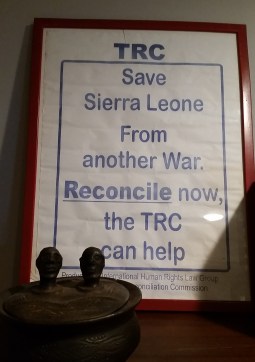 Consequently, Sierra Leone was about to initiate a Truth and Reconciliation Commission, to be followed by a War Crimes Tribunal. Thousands of posters were printed advising the populace to “Save Sierra Leone from Another War. Reconcile Now. The TRC Can Help.” The one poster I now have (picture) framed in my rec room I found with dozens of others carelessly stuffed into a cupboard in the offices of my human rights organization’s post-conflict mental health services.
It was a lovely dry evening during Sierra Leone’s rainy reason and five of us expat staff from various countries inside and outside the African continent seated ourselves at a table on the restaurant’s patio. After placing our orders for chicken and chips, the server, who must have misheard us, returned after a while with plates full of chicken and rice. While I was happy enough to eat what had been put before me, one of our party asked the server to take back the food and give us the correct order. Several minutes elapsed when we heard loud crashes of plates breaking and yelling by the cook. Then silence again. After quite a while our correct dinners were brought out, this time by a different server, who apologized for the scene.
2. Violence
In carrying out my field experience assignment I interviewed one of the expatriate psychologists, who served as clinical trainer and supervisor of “psychosocial agents” (PSAs)- local lay counselors for torture and war trauma victims from either Sierra Leone or Liberia. Expats spent from one to five years, depending on their willingness to work in hardship conditions. This expat was from South Africa, a young woman whose mother served as secretary to Rev. Desmond Tutu, one of the heroes of the anti-Apartheid movement. We talked about the traumatic violence that her clients had experienced and how she felt about the work. She admitted she was not prepared to hear about the level of bizarre violence that some clients revealed took place on the border of Guinea, Sierra Leone, and Liberia (e.g., forced cannibalism), despite her prior experience treating trauma victims in South Africa.
Her service location, Kailahun, required a six hour commute one way each week from Kenema to deliver counseling and supervision to the PSAs living there, where the rebel war began in 1991. The roads were heavily rutted and in this rainy month of August
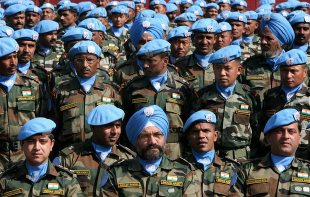
often flooded. To my surprise, however, she said she felt personally completely safe here, unlike in South Africa—even walking alone at night. The only fear she felt in post-conflict Sierra Leone was from the “blue hat” Ukrainian peacekeepers recreating in the local bars. The peacekeeping mission was launched by the United Nations (UNAMSIL) after the first ceasefire by the rebels in 1999, and ended in 2006.
3. Delivering mental health services in the bush
As part of my orientation to CVT’s Mental Health services in Sierra Leone I was invited to ride along with a Kenyan expat clinician Michael Kamau and his PSA supervisees, to see how services were delivered to Sierra Leonean returnees from Guinea refugee camps currently living out in the “bush” in small villages. It was the rainiest month of the year—August—and the mud roads were frequently impassible. After an initial stop at the offices in Blama town, where records are kept and meetings held, we headed out. Everyone was in good spirits. Our first bush town was Kalia, which was way off the grid. Along the road people started warning us that the road into Kalia was out. Our 4×4 kept going over flooded wood plank bridges. At some point the water became too deep for the car to go through and the wooden bridge was floating atop the water. We reluctantly turned around, calling a message across the floodwaters to the locals that CVT Mental Health would return the following week. 
Our next stop was another small village farther up in elevation. There we visited the home of a young man whom Michael was treating for psychosis. Because of uncontrolled symptoms, he had been forced to drag around a heavy chain on his leg wherever he went to keep him from running away or getting into trouble. Michael, a psychiatric nurse, had diagnosed him with drug-induced psychosis, as a result of being forced to become a child soldier, with its attendant atrocities, and given cannabis to lower inhibitions in the fighting. Michael referred him to the local hospital where he was given anti-psychotic medications. Now his chain was gone and his mother reported that he was “small, small” better. She also reported that he had started to go to the family farm and help out. She said his main problem now was talking too much. As we talked, I observed that we were sitting on the family’s front porch doing a client visit with about ten adults and twenty children standing by listening, four PSAs, Michael and me. Confidentiality is pretty low on the list of professional requirements in a post-conflict village. But results are pretty high.
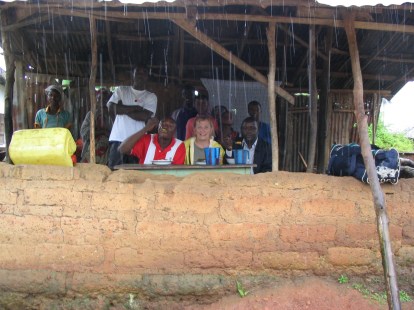 In the early afternoon we began the return to the office in Blama with a stop along the way for lunch. It was a small roadside stand, rather like a lean-to. For 500 Leones (35¢) we had a nice big bowl of rice with cassava leaf sauce. It was really quite tasty and peppery–a more nutritious meal in a poor country than many an American meal these days.
4. Flight Safety Instructions
At the end of my field experience visit I arrived back at the outdoor, roofed waiting area near the helicopter pad from which a copter takes you to Lungi airport, on the tip of a peninsula outside of Freetown. In the waiting area a man in a very loud voice began a very dramatic demonstration of the safety procedures to be used on the flight. “Be sure to buckle seat belts”, followed by detailed and colorful instructions on the use of the flotation device. The instructions ended and were followed by a request for money for “the people of Africa.” Everyone laughed, assuming it was a joke. He passed two baskets and no one put anything in. But finally one African man put a bill in the basket and I was confused. Was it an act or not? We then boarded the Soviet era shabby helicopter, packed in tight. I looked for my seat belt. There were none! I looked under the seats—no flotation devices! It made me laugh. I still didn’t get Africa.
 Other states, other lives, other souls